Oct 8, 2026Tool Knowledge & Comparisons
Windshield Removal Wire vs Cold Knife: What's the Difference?
Compare windshield removal wire and cord systems with cold knives: how each cuts the urethane bond, where access matters, and what auto glass tool buyers should confirm.
1. Quick Answer
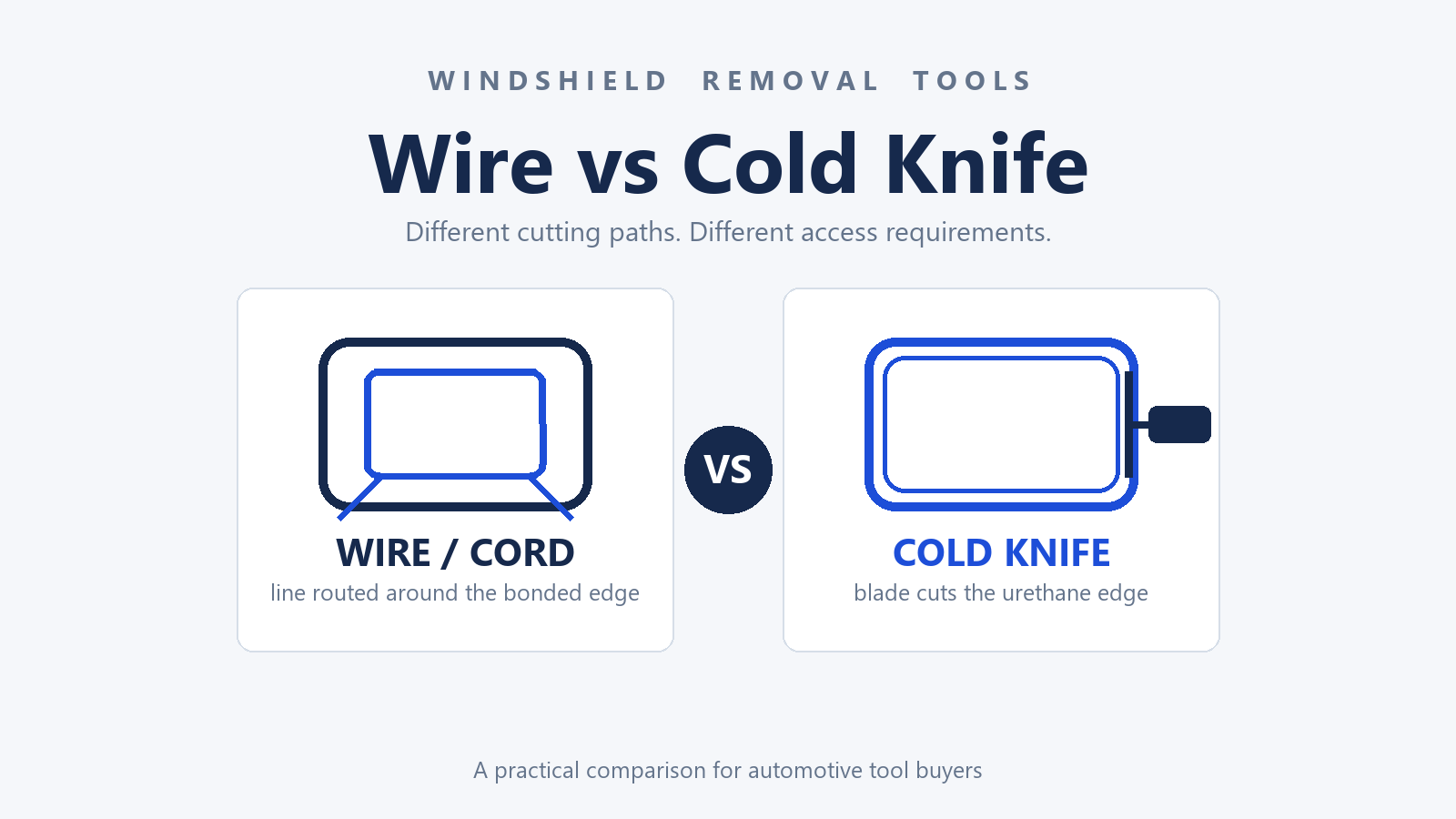
A cold knife uses a blade to cut through the urethane bond that holds a bonded windshield to the frame. Wire and cord systems draw a cutting line through the adhesive around the bonded perimeter. Neither is universally better: the access around the glass, the glass geometry, the surrounding trim and the removal setup determine which approach fits.
2. How a Cold Knife Removes Bonded Glass
A cold knife cuts the bond from the edge inward. The blade enters the urethane bead that runs around the glass perimeter and is worked along it to separate the bonded glass from the adhesive line. Nothing is drawn through the adhesive from the far side; the tool works wherever the blade can reach the bond line.
That makes blade geometry and reach the working variables. The blade has to sit at the right angle to the bond, follow the perimeter, and reach the adhesive along the top and side edges where the glass meets the frame. Where the edge is obstructed, or the bond runs deep behind trim, the blade has to follow the same obstruction.
3. How Wire and Cord Removal Systems Work
Wire and cord systems cut with a line rather than a blade. A cutting wire or cord is routed into position and drawn through the urethane around the bonded perimeter, so the adhesive is separated along the whole path the line follows. The physical work happens along a routed line rather than at a single blade position.
How the line is moved depends on the system: some setups anchor the wire and pull it through, others use winding reels, and grips or handles are used to hold and draw the line. Starting the cut is its own step — suppliers sell wire starters and guides whose job is to push the wire through the urethane and route it under trim. Routing is the practical constraint, which is why access and the choice of entry points matter as much as the line itself.
4. The Main Difference: Cutting Path and Access
Blade contact versus line contact: a cold knife cuts at one point and moves along the edge, while a wire or cord cuts along a routed path through the adhesive. The two produce different working positions at the glass.
Edge access versus routed access: a cold knife needs clear access along the glass edge and the bond line. A wire or cord needs a route in and around the perimeter, plus room to draw or wind the line. The access limits are different, so an obstruction that restricts blade travel may affect a routed line differently, and vice versa. The practical choice therefore has to be checked against the actual bond path and surrounding clearance.
Corners, dashboards, headliners and mouldings all shape the choice. Obstructions that limit where a blade can travel also limit where a line can be fed, and the two limits rarely fall in the same place. Interior trim and mouldings often have to be removed or displaced to reach the bond, and both manual approaches work around those obstacles rather than through them. Glass geometry adds another constraint: curvature, edge shape and how the glass sits in the frame can affect access to the bond path for either method.
5. Where Powered Removal Tools Fit
Powered options also exist in the market — reciprocating and oscillating tools, and powered cold-knife systems — as their own product families alongside the manual methods. They are a third common approach rather than a replacement for either one, and the same questions apply to them: what the tool cuts, how it reaches the bond, and what clearance the setup allows.
6. What Tool Buyers Should Compare
Removal method: which cutting approach the tool supports, stated in writing.
Cutting element: blade type for a knife, or wire and cord type for a line system.
Reach and access: how far the tool works along the bond and what clearance it needs.
Included components: handles, anchors or winding tools for a wire system; blade and holder geometry for a knife.
Consumables: replacement blades, wire or cord, since these decide the ongoing cost of using the kit.
Protective accessories and written kit contents, plus packaging and private-label options.
TEKO’s Windshield Removal Tool Set, for example, is a five-piece set documented for the removal or release of bonded windshields, windshield molding, butyl adhesive compound and trim pads. It sits in the Body, Trim & Glass Tools range. It contains triple-braid galvanized steel wire with two gripping handles, a windshield removal tool (rubber gasket knife), a wire feeder tool, a trim pad remover and a windshield molding release tool. The published kit contents — not the product name — are what a buyer sets against the removal work, exactly as the comparison above uses method, reach and access rather than category labels.
7. Common Selection Mistakes
The recurring mistakes in this category are selection mistakes:
Buying by piece count, when what matters is which methods and consumables the pieces cover.
Assuming every windshield presents the same access, when edge clearance and routing space differ.
Treating wire and cold knife as automatically interchangeable, when they solve different access problems.
Ignoring replacement blades, wire or cord, which decide the ongoing cost of running the kit.
Relying on product photos instead of written kit contents.
Each item is checkable before an order is placed.
8. What Distributors Should Confirm Before Ordering
Put these points into the inquiry:
Target market and the glass-removal work it involves
Preferred removal method or combination of methods
Required tools and consumables
Preferred kit configuration
Estimated quantity
Branding and packaging requirements
If you are building out an auto glass tool range, send us your target market and kit requirements through our inquiry form, along with your preferred removal method, required kit contents, a reference tool or current kit if available, your quantity, and any private label, OEM, branding or packaging requirements — and we will confirm what we can support.
Frequently Asked Questions
What is the difference between windshield removal wire and a cold knife?
A cold knife cuts the urethane bond with a blade worked along the glass edge. A wire or cord system draws a cutting line through the adhesive around the bonded perimeter. Blade contact and routed line contact are different ways of separating the same bond.
Is wire removal better than a cold knife?
Not universally. Which suits depends on edge access, the route a line can take around the perimeter, glass geometry and the trim around the glass. The two solve different access problems rather than ranking as one better tool.
What does a cold knife cut?
The urethane adhesive bond between the bonded glass and the frame. The blade follows the bond line around the perimeter to cut through the adhesive.
Why do windshield removal kits include different cutting tools?
Because removal work varies: a kit may combine wire or cord with handles, a knife, and tools for trim and molding, so a workshop covers more glass and trim situations with one set. The written kit contents show what is actually included.
What should buyers confirm before ordering windshield removal tools?
The removal method supported, cutting element and consumables, reach and access requirements, included handles or winding tools, protective accessories, written kit contents, and any packaging or private-label requirements.