Oct 7, 2026Tool Knowledge & Comparisons
Clic-R Pliers vs Spring-Band Hose Clamp Pliers: What's the Difference?
Compare Clic-R and spring-band hose clamp pliers, including jaw design, locking method and access requirements. A practical guide for automotive tool buyers.
1. Quick Answer
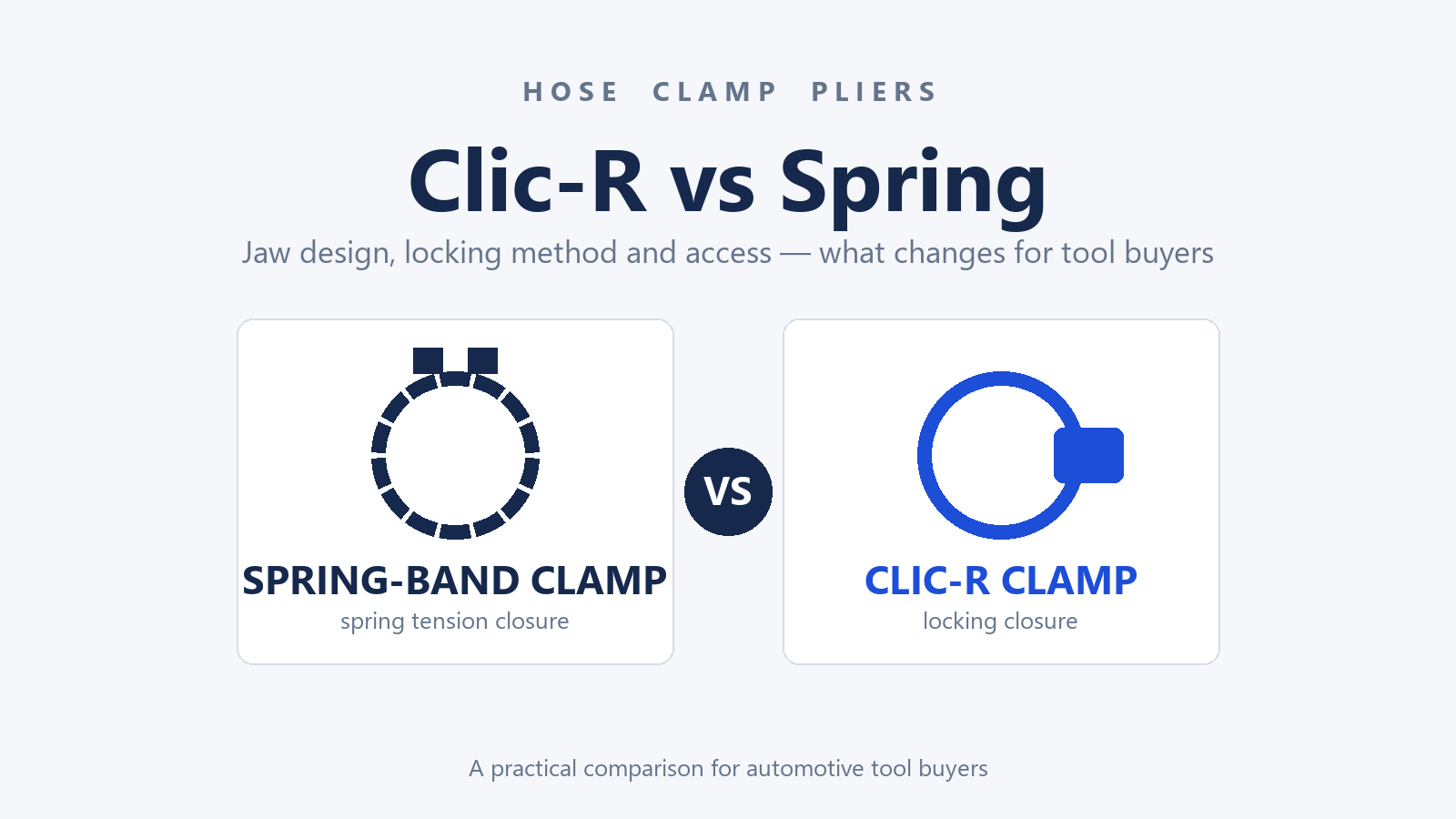
Clic-R and spring hose clamps are both self-tightening designs, but they do not close the same way, and the pliers built for them differ in jaw design, engagement and release. Spring-band clamps hold their clamping force through the spring properties of the band. Clic-R clamps are a self-tightening spring clamp family with a locking closure, fitted and removed with dedicated pliers. "Hose clamp pliers" is therefore not one tool: match the plier design to the clamp types your market actually uses, and treat the name on the box as a starting point rather than a specification.
2. How Spring Hose Clamps Work
A spring-band hose clamp is a one-piece, bolt-free clamp. Its clamping force comes from the spring properties of the band, which the clamp manufacturer describes as an automatic re-tensioning effect over long periods as temperatures fluctuate. That elasticity is the point of the design: the clamp keeps pressure on the hose without a screw.
For tool selection, the job is specific. The plier has to open and hold the clamp so it can slide over a hose spigot, and do the same in reverse for removal. The clamp maker sells a dedicated handheld plier for installing and removing its spring-band clamps, with a safety lever that fixes the plier in position. Tool makers describe the same job from the tool side: cross-cut tips that grip the clamp from multiple angles, and a ratcheting lock that holds the clamp open for hands-free use.
3. How Clic-R Clamps Differ
Clic-R is a branded name — the manufacturer writes it CLIC® R — not a generic category label. The clamps are self-tightening spring clamps with a locking system: quick to fit with manual or pneumatic pliers, removable and reusable if disassembled with care. CLIC-R is the reinforced version of the base CLIC clamp, with capacity reserves that compensate for the tolerance ranges of hoses and pipe ends, and it is specified for fuel, oil, air and cooling systems among other automotive uses.
The tooling follows the closure. The manufacturer offers a separate range of manual tools to assemble and disassemble CLIC clamps, including disassembly pliers for maintenance and aftermarket work. A buyer looking at "Clic-R hose clamp pliers" is therefore looking at a tool for a locking-closure clamp family — a distinct engagement, not a second name for a generic spring-clamp plier.
4. Why the Pliers Are Not Automatically Interchangeable
The clearest signal comes from how suppliers organize their own catalogs. One tool maker lists hose clamp pliers in straight, angled, heavy-duty and corbin styles, "for use on flat band, corbin style and flat ear style hose clamps" — plier styles are named against clamp styles, not sold as one universal design. A clamp maker known for ear clamps sells separate pincers for ear clamps and closing tools for screw clamps. The CLIC family has its own assembly and disassembly tools. Three closure approaches, three engagement approaches.
What differs between plier designs is practical: where the tips engage the clamp, whether the tool expands and holds the band or works a locking closure, and how the jaw ends are shaped — on some straight pliers, one end is notched and the other open, because different clamps need different contact. A buyer comparing tools by the generic label "hose clamp pliers" may be comparing tools built for different closures. Ask which clamp types each design engages before comparing anything else.
5. Tight Spaces: Flexible Cable vs Direct-Access Pliers
Access is where plier selection gets concrete. Straight pliers need room in line with the clamp. Angled tips exist for hoses that sit behind an obstruction: one current design pairs 35-degree tips with a long reach for hard-to-reach hoses. Cable designs go further. A flexible cable tool with a 24-inch reach is described by its maker as access to clamps "difficult to reach with other tools", naming radiator hoses, heater hoses and fuel lines as the applications, with handles that squeeze to expand and hold the clamp in any open position.
None of this makes cable designs universally better. What these use cases share is distance and obstruction: when the clamp sits deep in an engine bay or behind components, a cable-and-remote-jaw design reaches it; when the clamp is within easy reach, a direct tool does the same job without parts in between. The positions your customers service should decide the mix, not the design category.
6. What Buyers Should Compare
A structured comparison beats a piece count. The points that change real orders:
Clamp types covered: coverage stated by clamp family — one official set, for example, documents five plier styles for flat-band and ring-style clamps — says more than any product photo.
Engagement: tip shape and where the tool grips, per clamp family.
Access: straight, angled or cable reach, set against the positions your customers service.
Holding function: ratcheting or lever locks that keep a clamp open hands-free.
Kit contents: in writing, not in pictures.
TEKO’s 9pcs Hose Clamp Pliers Set sits within the Automotive Specialty Hand Tools range. Use the published product information as the starting point and confirm the exact kit contents and clamp coverage for the target market before ordering.
7. Common Selection Mistakes
The recurring mistakes are ordinary and expensive:
Buying by piece count. A larger set is not automatically a closer match to the clamps in your market.
Assuming one jaw style covers every spring-type closure, including locking-closure designs.
Ignoring access until the tool reaches the workshop.
Judging by appearance photos instead of engagement and coverage documentation.
Ordering without written kit contents, then finding the gaps at goods-in.
Every item on this list is checkable before money moves, which is what makes them worth listing.
8. What Distributors Should Confirm Before Ordering
Put these points into the inquiry:
Target market and the clamp types common in it
Required plier designs: straight, angled, cable reach, locking-closure engagement
Kit configuration and which pieces are included
Estimated quantity
Branding and private-label options
Packaging requirements
If you are planning a hose clamp pliers program, send us your target clamp types and kit requirements through our inquiry form, along with your market, the expected configuration, quantity and any private label or OEM requirements, and we will confirm what we can support.
Frequently Asked Questions
Can Clic-R pliers be used on spring hose clamps?
They are listed as a dedicated tool for that locking-closure clamp family, not as a universal spring-clamp plier. Confirm the engagement with the supplier before assuming crossover.
What pliers are used for spring hose clamps?
Pliers that grip the band and hold the clamp open: tool makers describe cross-cut tips with a ratcheting lock, and clamp makers sell a dedicated handheld plier for installing and removing spring-band clamps.
When are flexible cable hose clamp pliers useful?
When the clamp is difficult to reach with a straight tool — deep radiator hoses, heater hoses and fuel lines are the applications named on cable-tool pages.
Is a larger hose clamp pliers set always better?
No. Coverage decides, not count: a set matches when its plier styles cover the clamp families your market uses.
What should buyers confirm before ordering a hose clamp pliers set?
Clamp types to cover, plier designs included, access and reach, locking functions, written kit contents, and any private label or packaging requirements.