Oct 7, 2026Tool Knowledge & Comparisons
Bearing Puller vs Press and Pull Sleeve Kit: What's the Difference?
Compare bearing pullers and press and pull sleeve kits: how each applies force, why diameter matching and access matter, and what automotive tool buyers should confirm.
1. Quick Answer
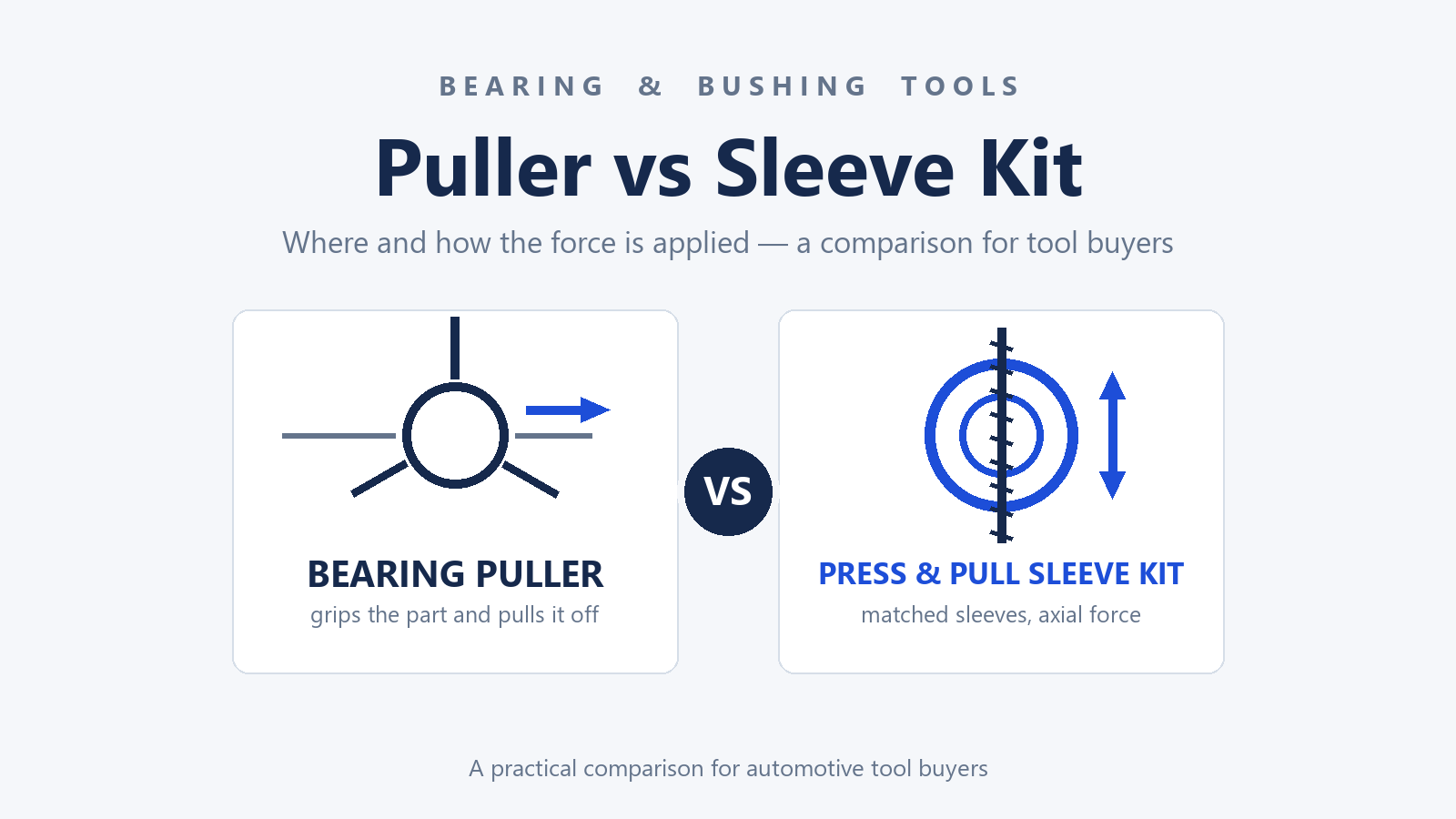
A bearing puller applies a pulling force through jaws or legs that grip the part itself, or a component behind it. A press and pull sleeve kit applies force along the axis of the assembly, using sleeves with matched diameters, a receiving support and a threaded rod. Which one fits depends less on the tool name and more on three practical things: the geometry of the component, the access around it, and where a safe support surface can be placed.
2. How a Bearing Puller Works
A puller's defining feature is its engagement point. The jaws or legs connect to the part, or hook behind it, so that tightening the spindle draws the component off the shaft or out of its seat. The force is concentrated at those contact points.
That engagement dictates the requirements. The jaws need enough grip surface on or behind the part, the legs need clearance to spread or contract, and the spindle needs travel as the component comes free. Jaw and leg geometry is not cosmetic: reach, spread and tip shape decide whether a puller can attach to the component at all. Manufacturers split the category on exactly this line — external pullers grip the component from the outside, internal pullers reach through a bore and grip from the inside, and reversible-jaw designs cover both.
3. How a Press and Pull Sleeve Kit Works
A press and pull sleeve kit works along the axis of the assembly instead. In the kit layouts the manufacturers publish, the arrangement is consistent: a threaded spindle runs through the setup, a hardened disc sits behind the part, a sleeve matched to the component diameter takes the force at the seat, and a nut or receiver closes the opposite side. Tightening the spindle drives the part along that axis — extracting or mounting, depending on the arrangement.
The makers of this kit family document it for extracting and mounting bearings, bushes and seals, and the sleeve count is the headline number in every kit description. Bearing manufacturers make the matching principle explicit on the fitting side: the right combination of ring and sleeve transmits force into the correct ring and minimizes the risk of damage. Diameter matching is the specification that carries this family.
4. The Main Difference: Where and How the Force Is Applied
Contact point: a puller grips where it can reach — the part's edge, a flange or a component behind it. A sleeve kit contacts the part through a matched diameter.
Direction: a puller draws the component outward, away from its seat. A sleeve kit drives force along the axis, pressing or pulling depending on the arrangement.
Support: a puller's reaction passes through its own jaws and spindle. A sleeve kit's reaction passes through the receiving sleeve, which is why that support must seat firmly against the housing or shoulder.
Component geometry decides between them. Pullers adapt to exposed, irregular parts; sleeve kits reward round assemblies with axial access. Neither design is the universal answer — the assembly in front of the tool decides.
5. When a Puller May Be the Better Fit
A bearing puller may be suitable when the part presents an edge, flange or recess that jaws can engage, when the pull direction is outward with room for the legs and spindle to work, or when one adjustable tool needs to cover components of varying sizes in the same program.
6. When a Sleeve-Based Press/Pull System May Be the Better Fit
A sleeve-based system may be suitable when the component has a defined diameter that a matching sleeve can seat against, when force has to travel along the axis without gripping the part's working surfaces, and when the housing offers a firm support position for the receiver. Matched diameter, axial access and receiver clearance are the three conditions to check before choosing it.
7. Access, Diameter and Support Matter More Than Tool Name
Product names bundle a lot of assumptions. Before comparing any two tools, write down four things: the target component and its diameter; the surfaces that can be gripped or supported; the working space around the assembly; and the sleeve and rod coverage the job requires. Two tools with similar names can apply force in completely different ways. The published specifications decide — not the label.
8. What Tool Buyers Should Compare
Application range: what the supplier documents the tool for, stated in writing.
Diameter or size coverage: the sleeve combinations list for a kit, the size specifications for a puller.
Jaw and leg configuration: reach, spread and tip shape for pullers.
Sleeve combinations and threaded rod sizes: confirmed against the required diameters.
Receiving and support components: what is included in the kit.
Replacement parts, documentation, packaging and kit contents.
TEKO’s Universal Bearing Puller, for example, is documented in six size specifications covering 2 to 10 inches, in carbon steel with a heat-treated, electrophoresis surface finish. TEKO’s Press and Pull Sleeve Kit lists 22 sleeve size combinations from 34/44 up to 80/90 mm and five threaded rods from M10 to M18. Both sit in the Suspension, Steering & Bearing Tools side of the range — and in both cases the published size list, not the product name, is what a buyer sets against the application.
If you are building out a bearing and bushing tools program, send us your application and required size range through our inquiry form, along with the tool type you currently use or a reference sample, your quantity, any private label or OEM requirements, and packaging requirements — and we will confirm what we can support.
Frequently Asked Questions
Is a bearing puller the same as a bearing press tool?
No. A puller grips and draws the part; press-type tooling applies force axially, typically through matched sleeves and a support on the opposite side.
When is a press and pull sleeve kit useful?
When the component has a matched diameter for the sleeve, axial access for the rod, and a housing surface that can support the receiving side.
Can one bearing puller fit every bearing?
No. Jaw reach, spread and clearance limit what each puller can engage, so the target component has to be checked against the size specifications.
Why does sleeve diameter matter?
Because the sleeve carries the force into the component. Bearing manufacturers' fitting guidance is explicit: the right combination of ring and sleeve transmits force into the correct ring and protects the raceways. The same matching logic makes sleeve diameter the core specification of a kit.
What should buyers confirm before ordering bearing and bushing tools?
Target component and diameter, gripping or support surfaces, working space, sleeve and rod coverage, kit contents and documentation — sent with the inquiry.