Oct 7, 2026Tool Knowledge & Comparisons
Internal vs External Coil Spring Compressors: What's the Difference?
Compare internal and external coil spring compressors: engagement points, strut geometry, spring dimensions and what tool buyers should confirm before ordering.
1. Quick Answer
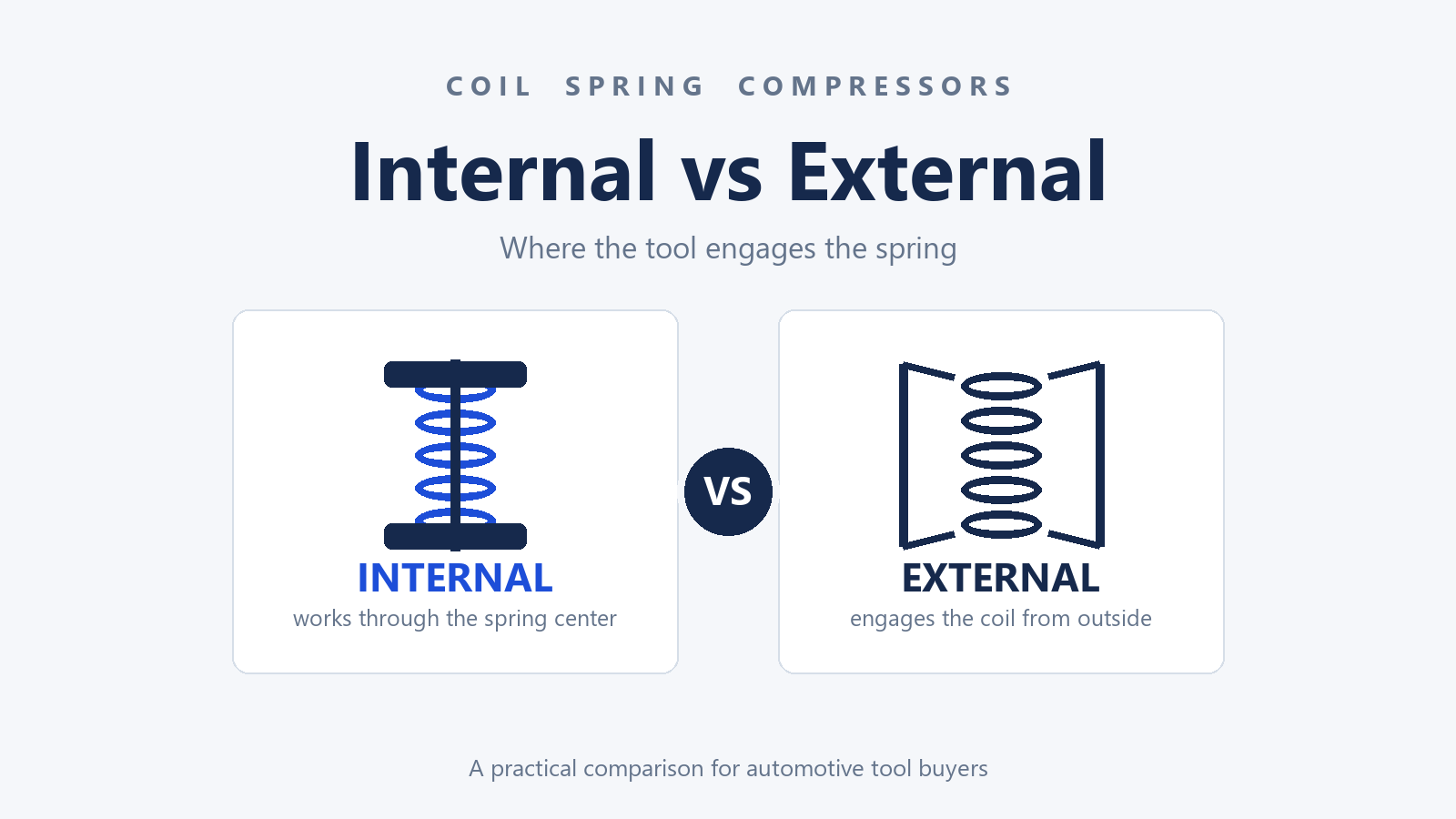
External-style coil spring compressors engage the spring from outside the coil, through hooks, latches or jaws that clamp the outer turns. Internal designs require access through the center of the spring and apply force with components that work inside the coil. Neither is universally better: suspension geometry, spring dimensions and the access a vehicle allows determine which tool fits.
2. How External Coil Spring Compressors Engage the Spring
External designs reach the spring from the outside, and supplier documentation states the use case directly: one manufacturer's external compressor is documented for springs where removal through the center of the spring is not possible. The documented arrangements vary — leg assemblies fitted evenly around the spring, or jaws that hook into the coils — but the engagement is from outside the coil, and the compression is drawn in gradually as the rods or nuts are tightened.
What this demands from the application is clearance. The legs or hooks have to reach around the coil and seat on the outer turns, the rods sit outside the spring's diameter, and the documentation is explicit about working gradually rather than compressing in one pass. Where those conditions hold, an external design covers the job without touching the spring's center.
3. How Internal Coil Spring Compressors Work
Internal designs work through the spring's center, and the definition comes straight from supplier documentation: internal compressors are listed for springs with access through the centre. One documented route is the shock opening — where a removable shock absorber leaves the center clear, the tool inserts through it and its arms engage the coils on opposed sides. Other kits use plates or discs that bear on the spring, with a bracket or aligning plate supporting the bottom end.
That is also why center access is a hard requirement for this family. If the spring's center is occupied or cannot provide the required access, an internal design may not be suitable for that application.
4. MacPherson Struts Change the Tool Geometry
MacPherson strut assemblies put the spring in a different position from springs that sit on a control arm or axle. The spring is retained between its upper and lower spring seats within the strut assembly, and manufacturer instructions describe compressing the spring until it is sufficiently clear of those seats. Strut-specific compressors therefore exist as their own tool group: paired rod-and-latch assemblies that hook over the top and bottom coils — with the manuals requiring both compressors on the same spring at the same time — clamshell designs with jaws and locking pins, and yoke-style kits with interchangeable yokes that also cover conical springs.
It is also why the name on the box settles so little. "Coil spring compressor" covers tools for springs on arms and axles, tools built around strut geometry and internal designs that need center access — different engagements, different clearances, different capacities. A buyer who only reads the generic name cannot tell which geometry a tool was built for; the application statement and the capacity range in the documentation carry that information.
5. Access and Spring Dimensions Matter
The dimensions that decide the choice are practical ones: the spring's inner diameter and outer diameter, the wire diameter that hooks and yokes are rated to grasp, the coil spacing that sets where a hook or plate can seat, the jaw or yoke range and maximum opening a tool offers, and the clearance around the assembly once it is on the vehicle or the bench. Supplier documentation lists these numbers explicitly — outside diameter limits, wire diameter limits, maximum openings — because a tool with the right engagement style still fails if its opening does not cover the spring. Confirming those numbers on both sides — spring and tool — is what prevents a mismatched order.
6. Safety Features Buyers Should Look For
Manufacturers document specific safety features on compression tools, and those features are order-relevant specifications, not extras. Latch locking pins and detent pins that hold the tool or coil in position, safety S-bolts and hooks that secure the spring, overload pins and safety yokes, and instructions covering gradual, even tightening and minimum compression all appear in supplier documentation. The same documentation carries the handling requirements — protective eyewear, no power tools on designs not rated for them, and no storage of a compressed spring. What the documentation does not do is rank designs by safety — the feature list is something to request, compare and confirm, not something to assume.
7. Common Selection Mistakes
The recurring mistakes in this category are selection mistakes, not usage mistakes:
Buying by product name alone, when the name says nothing about engagement or geometry.
Ignoring spring dimensions, so the tool arrives with an opening that cannot cover the coil.
Assuming one MacPherson compressor covers every strut spring, without checking capacity or engagement.
Overlooking center access, which is a precondition for internal designs.
Skipping the jaw or yoke range and relying on product photos instead of documentation.
Each of these is checkable before an order is placed, which is what makes the checklist worth running.
8. What Tool Buyers Should Confirm
Before requesting a quotation, put these points to the supplier:
Target suspension and spring type, and whether the application is strut-related
Internal or external engagement the application allows
Spring inner, outer and wire diameter if known
Jaw or yoke size range and maximum opening of the tool
Included safety or locking components
Instructions, documentation and kit contents
Packaging and private-label requirements
TEKO’s Heavy Duty Coil Spring Compressor, for example, is documented for MacPherson strut assemblies where space under the wheel arch is limited, with a stated capacity of 2.5 to 10.8 inches, carbon steel construction and safety retaining pins included. It sits in the Suspension, Steering & Bearing Tools range. The published application, capacity and safety features are exactly the fields a buyer sets against the target spring — the same fields this article has used to separate internal and external designs.
For a worked comparison of two other suspension tools by engagement and size coverage, see Bearing Puller vs Press and Pull Sleeve Kit. And if you are building out a suspension tool range, send us your target spring and tool requirements through our inquiry form, along with spring dimensions if available, a reference tool or photo, your required configuration, quantity, any private label or OEM requirements, and packaging requirements — and we will confirm what we can support.
Frequently Asked Questions
What is the difference between internal and external coil spring compressors?
Where the tool engages the spring. External designs clamp the coil from outside with hooks, latches or jaws; internal designs require access through the spring's center and apply force with components working inside the coil.
Are all MacPherson spring compressors external?
Strut-specific compressors are commonly documented as engaging the coil from outside the assembly, but the name alone does not confirm engagement. Check the tool's application statement and capacity range.
Why does spring diameter matter?
Because engagement depends on it: hooks and yokes have to reach around the outer turns, while internal components need suitable space inside the coil. Buyers should compare the spring dimensions with the tool's published opening, capacity range or other dimensional limits where provided.
Can one spring compressor fit every vehicle?
No. Suspension geometry, spring dimensions and access differ, and tools document a capacity range rather than universal coverage. Confirm the application against the tool's documentation.
What should distributors confirm before ordering?
Target suspension and spring type, allowed engagement, spring dimensions, jaw or yoke range and maximum opening, included safety components, documentation and kit contents, and packaging or private-label requirements.