Oct 2, 2026Buyer Guides
Radiator Pressure Tester Kit Buying Guide
Compare radiator pressure tester kits by cap coverage, gauge specifications and vacuum-refill functions. A practical buying guide for importers and distributors.
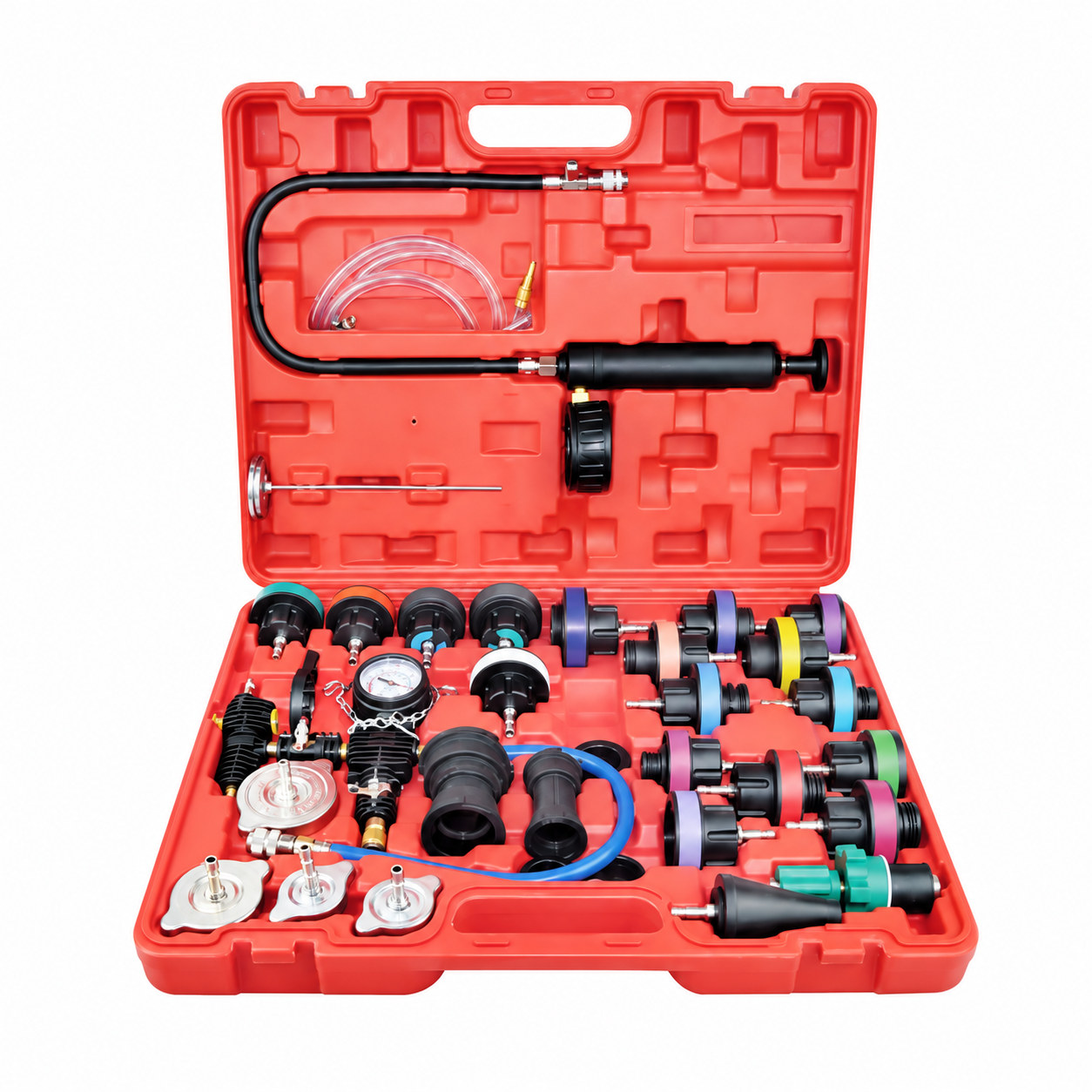
When buyers compare radiator pressure tester kits, the decision usually comes down to two questions: whether the kit’s test caps actually cover the cooling systems in your target market, and whether one kit should cover both pressure testing and vacuum-refill work. The piece count alone answers neither.
This guide sets out what importers, distributors and aftermarket brands should compare before ordering: cap coverage, the meaning of “universal” claims, the two jobs the kit is bought for, and the points to confirm in writing with a supplier.
1. What a Radiator Pressure Tester Kit Does
A radiator pressure tester kit is bought for two related but separate jobs. The first is cooling-system pressure testing: the pump pressurizes the system so that pressure loss can indicate a leak, while visible leakage may be easier to locate with the system under pressure, for example after a repair or when a system keeps losing coolant. The second is vacuum purge and refill: after cooling-system service, the air is drawn out so fresh coolant can fill the system without the air pockets that conventional filling can leave behind.
TEKO’s 28pcs Universal Radiator Pressure Tester Kit is configured for exactly this combination. The published contents list one pressure testing pump with hose, twenty-one test caps, a vacuum type cooling system purge and refill tool kit, a relief valve, a quick disconnect, a vacuum gauge, a universal adapter and a temperature gauge — twenty-eight pieces in eight component groups. The caps are specified “for most domestic & import vehicle cooling systems”, and that wording deserves a closer look before any order.
2. Why Cap Coverage Is the Core Buying Question
The test caps are the part of the kit that actually meets the cooling system, and cooling systems are not uniform. Filler necks differ across vehicle populations, which is why test caps come as a family rather than a single size.
Professional kits show how much the details vary: listings in this category describe anywhere from seventeen to twenty-three test caps, often with similar-sounding coverage claims. Two kits with the same number of caps can still cover different cooling systems, and a kit with more caps is not automatically the better fit for your market. Threaded filler necks are a further boundary: cap manufacturers treat threaded systems as a distinct fitment group that requires its own adapters.
The cap count is an inventory figure. The cap list — which caps, for which types of cooling systems — is the fitment information.
3. What “Universal” Actually Tells You
“Universal” in a kit listing is a broad coverage description, not a fitment specification. The wording of TEKO’s own kit follows the industry convention: the twenty-one test caps are specified “for most domestic & import vehicle cooling systems” — the qualifier is part of the official product description, and comparable professional kits use the same construction.
For a B2B buyer, “universal” should be read as: wide coverage by design, specific coverage only as documented. The practical response is not to reject universal claims but to ask for the list behind them — which caps, for which systems, with which gauge specification — and to check that list against the vehicles your market actually services.
4. Pressure Testing and Vacuum Refill Serve Different Purposes
The two functions are often bought in one kit because they serve different stages of the same service workflow. Pressure testing is a diagnostic step: it looks for pressure loss and the leaks behind it, and it can be used after a repair to confirm the system holds. Vacuum refilling is a service step: cooling systems can retain trapped air — airlocks — after draining, and vacuum-refill tools evacuate that air first, then use the vacuum to draw fresh coolant into the system. Trapped air is a real workshop problem — it can cause overheating and poor heater output. Some professional vacuum systems also use vacuum holding as part of a leak-check procedure before filling.
Whether a given kit’s vacuum function suits a market’s workflow is a supplier question: ask how the purge-and-refill tool connects and what equipment it requires. The two functions complement each other, but they answer different buying questions — coverage for the first, workflow fit for the second.
5. How to Verify Coverage for Your Market
Coverage is verifiable, but only against a list — never against a count. The method is straightforward:
Ask the supplier for the full test cap list in writing, together with the gauge specification.
Match the list against the cooling systems common in your target market, not against the coverage claim.
Ask how the caps are identified — colour coding, numbering or a case layout — so workshop users can pick the right cap quickly and missing pieces are visible during receiving checks.
Ask whether replacement caps or adapters can be supplied separately, especially for distributors planning long-term after-sales support.
A supplier who documents coverage precisely can be checked. A supplier who only says “universal” cannot.
6. What Buyers Should Confirm Before Ordering
Before requesting a quotation, put the questions above into your inquiry so the answers are comparable across suppliers:
Target market and the applications you need to cover
A written test cap list and gauge specification
How the vacuum purge-and-refill tool connects, and any equipment it requires
Preferred kit configuration and packaging format
Estimated quantity
Branding or private label requirements, if any
An existing product or reference sample, if you have one
If you are building out a testing & diagnostic tools range, comparing kits like for like — cap lists, gauge specifications and configurations — keeps quotations comparable across suppliers. And if you send branding or private label requirements with the first inquiry, packaging and labeling options can be reviewed alongside the product specification instead of after it.
Frequently Asked Questions
Does a higher cap count mean better coverage?
No. Cap counts differ between professional kits, and the number itself says nothing about which cooling systems the caps fit. Compare the documented cap list against your market, not the count.
Do I need the vacuum purge and refill function?
It depends on the service workflow your customers need. If vacuum purge and refill is part of their cooling-system service process, confirm how the tool connects and what supporting equipment it requires.
How do I confirm a kit covers my target market?
Ask for the test cap list and gauge specification in writing and check them against the cooling systems your market services. Treat “universal” as a broad coverage statement that still needs that check.
What should I include in an inquiry to a supplier?
Your target market, the applications to cover, a request for the written cap list and gauge specification, estimated quantity, and any branding or packaging requirements — plus a reference sample or existing product if you have one.
Sourcing Radiator Pressure Tester Kits for Your Product Range?
Send your target market and the applications you need to cover, request the full test cap list and gauge specification in writing, and include your estimated quantity and any branding or packaging requirements — or share an existing product or reference sample — through our inquiry form, and we will confirm what we can support.