Sep 29, 2026Buyer Guides
How to Choose a Brake Caliper Wind Back Tool Kit
A larger piece count is not automatically a better wind-back kit. What importers and distributors should compare: adapters, winding direction and fitment.
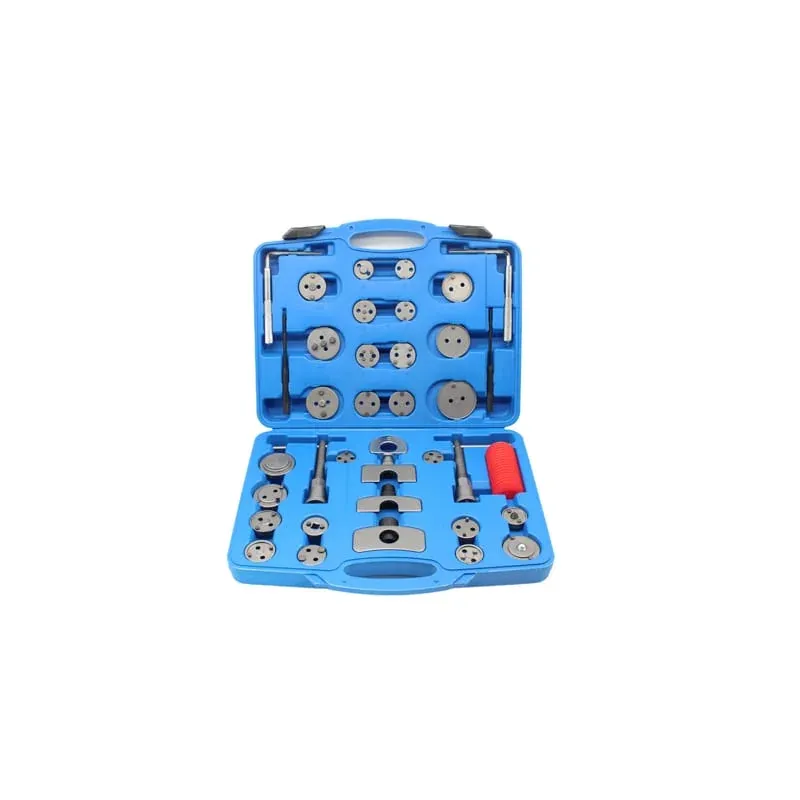
When you compare brake caliper wind back tool kits, the largest number on the page is the piece count — and it is also the least useful figure on its own. A larger kit is not automatically the better sourcing choice. What matters is what the listed pieces actually represent, and whether the tool’s configuration matches the brake calipers and vehicles in your target market.
This guide sets out what importers, distributors and aftermarket brands should compare before ordering: kit composition, winding direction, adapter profiles, fitment claims, kit organization, and the choice between mechanical and pneumatic designs.
1. Piece Count Alone Does Not Tell You the Coverage
A kit listed as 18 pieces or 37 pieces tells you little on its own about how many adapters are inside. Listed pieces typically include the tool body or bodies, thrust bolts, reaction plates and the storage case — not just the adapters. Some professional 18-piece sets, for example, consist of a holder, right-hand and left-hand thrust-bolt bodies and fifteen adapters, meaning only fifteen of the eighteen pieces are adapters.
That is why two kits with the same piece count can cover entirely different ranges of calipers. When you evaluate a listing, ask the supplier to break the configuration down: how many pieces are adapters, how many are working tools, how many are plates or accessories. The breakdown, not the total, is what you compare against your market.
2. “Wind Back” and “Rewind” Refer to the Same Buying Category
Suppliers use two names for this category: brake caliper wind back tool and brake caliper rewind tool. Both are common in listings, catalogs and search, and both describe the same job — retracting a screw-in caliper piston by rotating it back into its housing. There is no fixed rule for which term appears where; professional suppliers use both.
For a buyer the implication is practical: compare kits by searching catalogs under both terms, and if you list the product yourself, use both phrases so your offer can be found either way.
3. Check the Winding Direction Before Comparing Kits
Calipers with an integrated parking-brake mechanism hold the piston on a threaded adjuster, so the piston has to be screwed back into its housing rather than pressed straight in. That is the job a wind back tool does.
The critical detail is direction. Both right-hand and left-hand threaded caliper pistons exist in the vehicle population, and the required rotation depends on the caliper design, so buyers should not assume that one winding direction covers every application. This is why professional kits are built with right-hand and left-hand thrust-bolt assemblies, and why manufacturer instructions state that the handle turns clockwise or anticlockwise depending on the caliper’s thread.
Treat winding direction as a configuration question, not a footnote: before ordering stock, confirm with any supplier whether the kit operates right-hand threads, left-hand threads, or both — and which of those your target applications require.
4. Adapter Profile Matters More Than Adapter Count
Adapters are the part of the kit that actually meets the caliper piston, and piston faces are not uniform. Some have two pin holes, some have three, some have slots or recesses, and adjustable-pin adapters exist to bridge the variations. A two-pin adapter will not engage a three-pin piston, so a kit with fifteen adapters is only as good as the profiles those adapters match.
The drive interface is worth checking too: confirm the drive fitting of any kit you compare before ordering. TEKO’s 37-piece brake caliper wind back tool kit, for example, is specified with a 3/8-inch internal square drive fitting.
When you compare kits, ask for the adapter list with profiles — pin counts, pin spacing, adjustability and diameters where relevant — and match that list to the calipers in your market. More adapters are useful only when they match the applications you need to cover.
5. Do Not Treat “Universal” as a Complete Fitment Specification
Even professional tool manufacturers commonly qualify “universal” coverage with terms such as “most vehicles” and still instruct users to verify the application against vehicle-specific service information. For a B2B buyer, “universal” should therefore be treated as a broad coverage description, not a complete fitment specification.
A named coverage statement is easier to verify than a generic one. TEKO’s 37pcs Brake Caliper Wind Back Tool Kit, for example, is published with a named vehicle list — Audi, BMW, Ford, Honda, Mazda, Mitsubishi, Nissan, Opel, Saab, Toyota, Volvo, VW and others — so a buyer can check the named makes against their market and ask about the rest.
When you evaluate any kit, replace “does it claim universal coverage” with two sharper questions: which applications does the supplier document, and can they confirm in writing that those applications match the vehicles that dominate your market?
6. Identification and Case Organization Matter in a Multi-Adapter Kit
In a multi-adapter kit, organization can affect both workshop use and incoming inspection. Buyers should check how the adapters are arranged in the case, whether the contents can be identified clearly, and whether an application chart or instructions are supplied where needed. A defined case layout can also make it easier to spot missing components during receiving or after-sales checks.
7. Mechanical vs. Pneumatic Is a Separate Buying Decision
Mechanical and pneumatic wind-back tools should be treated as separate sourcing options. Pneumatic versions require a workshop air supply, while manual kits do not.
Confirm the form factor your customers need first, then compare coverage within it. The two questions do not substitute for each other.
8. What Distributors Should Confirm Before Ordering
Before you request a quotation, put the questions above into your inquiry so the answers are comparable across suppliers:
Target market and the applications you need to cover
Required winding direction — left-hand, right-hand, or both
Required adapter profiles or configuration, if known
Preferred kit configuration and tool form (mechanical or pneumatic)
Estimated quantity
Branding requirements, if any
Packaging requirements
An existing product or reference sample, if you have one
If you are building out a brake service tools range, comparing kits within the category — like for like on drive fittings, adapter profiles and packaging formats — keeps quotations comparable across manufacturers.
Frequently Asked Questions
Does a higher piece count mean a better kit?
No. The total can include tool bodies, thrust bolts, plates and the case, and only the adapter profiles and documented coverage determine what a kit actually fits. Compare configuration and application match, not totals.
Do I need a kit that handles both left- and right-hand threaded calipers?
It depends on the vehicles in your target market — both thread directions exist. Confirm the applications you need to cover and make winding direction an explicit item in your supplier inquiry rather than an assumption.
What does “universal” mean in kit listings?
It is a broad-coverage description, not a fitment guarantee — professional manufacturers qualify their own universal claims with “most”. Ask for the documented application list and verify it against your market.
What should I include in an inquiry to a supplier?
Your target market, the applications to cover, winding-direction requirements, preferred configuration, estimated quantity, and any branding or packaging requirements — plus a reference sample or existing product if you have one.
Comparing Brake Caliper Wind Back Kits for Your Product Range?
Send your target market, the applications you need to cover, your preferred kit configuration, estimated quantity, and any branding or packaging requirements — or share an existing product or reference sample — through our inquiry form, and we will confirm what we can support. For OEM and private label projects, branding and packaging options can be reviewed alongside the product specification.