Buyer Guides
How to Choose a Piston Ring Groove Cleaner: Piston Range, Cutter Sizes & Groove Width
Choose a piston ring groove cleaner by piston range and cutter size — 51–127 mm, three cutter heads, and the groove-width checks to confirm before ordering.
1. Quick Answer
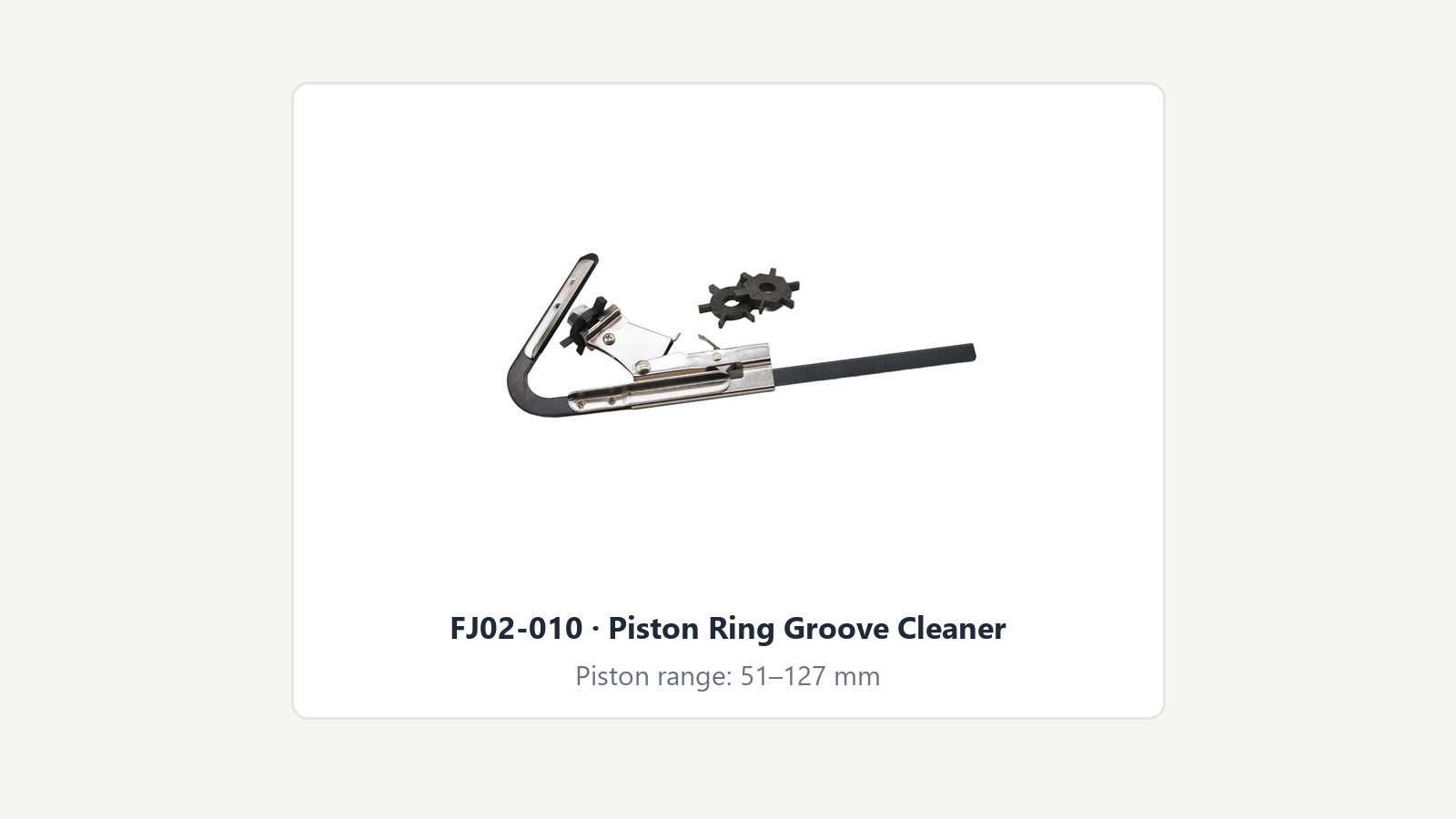
A piston ring groove cleaner should be selected from two separate published axes: the piston diameter range the tool is built to handle, and the cutter sizes it ships with. The TEKO FJ02-010 publishes a 51–127 mm piston range and three cutter heads covering 18 groove-width sizes in inch and metric dimensions. Specification coverage does not confirm application compatibility — before ordering, confirm the groove widths and applications against the published lists, and flag the details the published data does not state, such as replacement cutter availability and the drive or operating method.
2. Piston Range Is Not Cutter Compatibility
A piston ring groove cleaner carries two published figures that answer two different questions. The piston range — 51 to 127 mm on the FJ02-010 — describes the published range of piston diameters the tool is listed for. The cutter sizes describe the ring groove widths the cutters are shaped to clean.
The two axes do not determine each other. A piston inside the published range does not tell you which cutter matches its ring grooves, and a cutter that matches a groove width does not tell you whether the tool spans that piston's diameter. Selecting a groove cleaner means checking both: the piston diameter against the published range, and the groove widths against the published cutter lists.
3. Reading the Three Cutter Size Lists
The FJ02-010 is published with three cutter heads, and the published data enumerates every size:
Cutter #1: 1/16″, 5/64″, 3/32″, 1/8″, 5/32″, 3/16″. Cutter #2: 2 mm, 2.5 mm, 3 mm, 4 mm, 4.5 mm, 1/4″. Cutter #3: 1.2 mm, 1.5 mm, 1.8 mm, 2.8 mm, 5 mm, 5.5 mm.
Together the three lists span 18 sizes, and the published figures mix inch and metric dimensions. Makers of this tool design publish the same size coverage. Read each figure as its own published size: the data does not state that an inch figure and a metric figure are interchangeable, and it does not publish tolerances, blade thicknesses or edge treatments — those attributes should not be inferred from the numbers alone.
4. Worked Examples: Reading the Two Axes
Example A: an 80 mm piston with a 1.5 mm cutter requirement. 80 mm falls inside the published 51–127 mm piston range, and 1.5 mm appears in the published Cutter #3 list. Both figures sit inside the published data — and that is all this comparison confirms. Whether the 1.5 mm cutter suits the actual ring groove on that piston depends on the groove width itself, which the published data does not state per piston.
Example B: a 130 mm piston. That diameter sits outside the published 51–127 mm range. Based on the published specification alone, the tool is not selected for that application — anything outside the published range needs a separate conversation with the supplier.
Specification coverage does not confirm application compatibility, and these examples are not a recommendation of one configuration over another.
5. Matching the Cutter to the Groove Width
The published cutter lists are matched against the ring groove width. Groove widths are set by the engine maker's design, and the working practice published across this tool category is to select the cutter whose width figure corresponds to the groove to be cleaned — then verify the result rather than assume it.
Verification practice is published by piston manufacturers. After cleaning, the ring grooves must be free from carbon and dirt, the rings should rotate freely in their grooves, and a new ring should seat completely in the groove around its full circumference. Piston makers also publish side-clearance wear limits for used pistons — checked with a new ring and a feeler gauge — and their published thresholds separate reusable pistons from worn ones. Those thresholds are the piston maker's criteria: they are not TEKO published figures, and the actual repair standard for a used piston is set by the applicable engine maker's specification.
6. Cleaning Carbon Is Not Repairing the Groove
Removing carbon and glaze from a ring groove restores a clean groove — it does not repair wear. Piston manufacturers' technical guidance draws the line explicitly: the lower side of a ring groove acts as a sealing surface, and scratches there can increase oil consumption and blow-by. Whether a cleaned groove still meets its limits is judged against the requirements of the applicable engine or piston maker — grooves worn beyond those limits are a replace-the-piston condition, not a cleaning task.
That boundary is also why the published data for the FJ02-010 stops where it does. The tool is published for removing carbon and glaze deposits — the description covers cleaning, and nothing in the published data extends it to re-cutting, re-machining or correcting a worn groove.
7. What the Source Data Does and Does Not Publish
The published record for the FJ02-010 covers the model, the application statement, the piston range, the three cutter size lists, a carbon steel material note and the packing data. Several details a buyer may need are not part of it:
Whether replacement cutters are offered separately for any of the three cutter heads. The drive or operating method. Blade edge treatment, hardness figures or material compatibility beyond the published carbon steel note. Any application statement for specific engine families — the published application covers piston ring grooves generically.
Each is a confirm-before-ordering item rather than an assumption.
8. TEKO Confirmed Configuration — FJ02-010
FJ02-010, the Piston Ring Groove Cleaner, is documented for fast and reliable removal of carbon and glaze deposits from piston ring grooves, suitable for pistons between 51 and 127 mm. The published configuration comprises three cutter heads covering 18 groove-width sizes — the complete size lists are set out in section 3 above. The published material is carbon steel, the weight is 304 g, and the packing is an opp bag at QTY 50 with G.W./N.W. 16.5/15.5 kg, MEAS 48×33×26 cm. It sits in the Engine Service Tools range.
For a program built around piston ring service, the groove cleaner pairs with the ring installation stage — see our Piston Ring Compressor Size Guide for how ring compressors are selected.
9. What Buyers Should Confirm Before Ordering
For importers and distributors specifying a groove cleaner program, the published record supports a short checklist:
The piston diameters to cover, checked against the published 51–127 mm range. The ring groove widths in the target applications, checked against the three published cutter lists. Estimated order quantities, target market, and packaging or branding requirements. The published packing is an opp bag at QTY 50 — packing data, not a minimum order quantity or a delivery commitment.
Packaging and private-label options are confirmed with the order discussion so the cartons and labels match the program.
10. Frequently Asked Questions
Is the piston range the same as the cutter sizes it covers?
No. The piston range and the cutter size lists are separate published fields, and one does not tell you the other.
Are the inch and metric cutter sizes interchangeable?
The published data lists them as distinct figures and does not state equivalences. Match the cutter to the groove width as specified by the engine maker's documentation.
Can a groove cleaner repair a worn ring groove?
No. The published application is the removal of carbon and glaze deposits. Worn-groove assessment and repair follow the applicable engine maker's criteria.
Are replacement cutters available?
Not stated in the published data. Confirm replacement cutter availability with the supplier before ordering.
Is QTY 50 the minimum order quantity?
No. QTY 50 is the published opp-bag packing quantity — packaging data, not a purchase minimum or a delivery commitment.
11. Request a Configuration Check
Send us the piston sizes, groove widths and applications you need to cover, together with estimated order quantities, target market and packaging or branding requirements. We will review the requirements against the published specifications and flag any details that need factory confirmation.
---