Oct 4, 2026Buyer Guides
Brake Line Flaring Tool Kit Buying Guide
Compare brake line flaring tool kits by flare format, tube size coverage and RFQ documentation. A practical buying guide for importers and distributors.
When buyers compare brake line flaring tool kits, the details that matter most are not the piece count or the carry case. They are the flare formats the kit is designed to form, the tube sizes it covers, and whether the supplier documents both. Those points decide whether one kit can serve your market, and they should be confirmed in writing before an order is placed.
This guide covers the flare formats commonly encountered in automotive brake line service, how to read tube size coverage on a kit listing, why tool configuration matters more than the piece count, and what to put in an RFQ.
1. What a Brake Line Flaring Tool Kit Does
A flaring tool kit forms the end of a brake line so it can seal against its mating fitting. After a line is cut or a damaged section replaced, the new end has to be formed to the correct format and diameter before the joint is made. Workshops use these kits whenever lines are repaired or replaced, which is why they are a stock item in brake tool ranges.
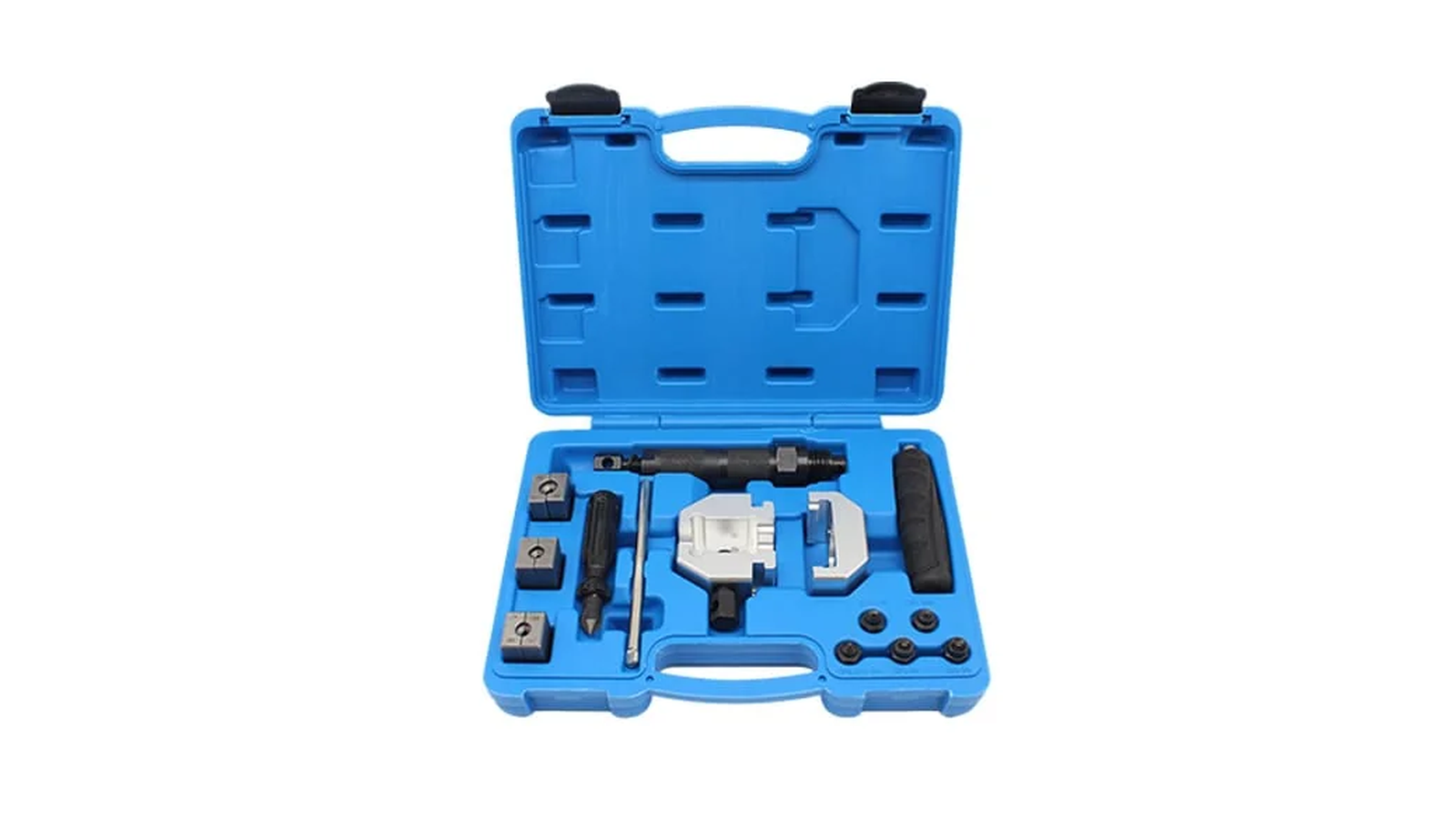
TEKO’s 18pcs Hydraulic Flaring Tool Set is specified for forming brake line ends during repair or replacement work. The published specification covers 3/16-inch, 4.75 mm, 5 mm and 6 mm standard brake line sizes through its clamp pairs, with saddle combinations extending coverage to 1/4-inch applications. For a specific brake-line program, confirm the required flare format with us before ordering, as flare compatibility should be verified separately from tube-size coverage.
2. Why Flare Type Is the First Question to Settle
Two flare formats are commonly encountered in automotive brake line service. The SAE 45-degree double flare folds the tube end over before flaring, doubling the material at the flare. The DIN/ISO bubble flare forms a rounded, protruding end that seals as the fitting is tightened. Usage varies by vehicle platform and market, so the formats a workshop needs depend on the vehicles it services. A 37-degree AN flare may also appear in aircraft and some aftermarket or high-performance applications, but it is a different fitting system from the SAE 45-degree double flare and DIN/ISO bubble flare commonly encountered in OEM-style brake line service.
Two points from industry practice matter for buyers. First, flare formats are not interchangeable: a replacement line must carry the same flare format as the original. Second, a plain single flare is not used on steel brake line service.
Flare format therefore needs to be settled before anything else. If the formats a workshop needs are not matched to the kit, the kit cannot serve its market, whatever the piece count. Because listings do not always state the formats a kit forms, ask any supplier to confirm — in writing — which flare format or formats the kit is designed to form.
3. Reading Line Size Coverage on a Kit Listing
Tube size is the second axis. Industry references commonly place the 3/16-inch size on passenger cars, and it is often discussed alongside 4.75 mm as a close metric nominal size. The two figures are not automatically identical, so buyers should verify the exact tooling specification for any kit.
A kit listing should state, size by size, what the tool covers. TEKO’s 18-piece set, for example, publishes its coverage directly: clamp pairs for 6 mm–1/4-inch, 5 mm, and 4.75 mm–3/16-inch lines, with saddle combinations extending across those sizes and to 1/4-inch. Set that documented list against the vehicles your customers service most: the match between the two is what turns a size list into a coverage decision. A size missing from the list is a gap to find before the order, not after.
4. Why Tool Configuration Matters Beyond Piece Count
Piece count alone does not tell you what sizes a kit covers. What matters is the combination of clamps, saddles and forming components supplied for each tube size.
TEKO’s set, for example, lists the body, counter-pressure plate, spindle, screw-clamping handle, clamp pairs and saddles, together with the published size coverage. For sourcing, compare the clamp and saddle combinations against the tube sizes you need instead of relying on the total piece count.
5. What to Verify for Your Target Market
Before ordering stock for a market, confirm four points:
Flare formats: ask the supplier to state in writing which flare format or formats the kit forms.
Tube sizes: match the documented size list to the vehicles your customers service most.
Tubing materials: if your market works with stainless or coated line, ask directly what the tooling is suited for — material suitability differs between kits.
Documentation and spares: ask whether the configuration list, instructions and replacement saddles or spindles are available separately.
Written answers to these points make supplier quotations easier to compare on the same basis.
6. What Buyers Should Confirm Before Ordering
Before requesting a quotation, put these points into your inquiry:
Target market and the vehicles your customers service
Required flare format or formats — stated and confirmed in writing
Required tube sizes
Preferred kit configuration and packaging format
Estimated quantity
Branding or private label requirements, if any
An existing product or reference sample, if you have one
If you are building out a brake service tools range, comparing line-forming kits like for like — flare formats, size lists and configuration — keeps quotations comparable across suppliers. And if you send branding or private label requirements with the first inquiry, packaging and labeling options can be reviewed alongside the product specification.
Related guide: if your range also covers caliper service, How to Choose a Brake Caliper Wind Back Tool Kit sets out the selection checks on the wind back side of a brake tools program.
Frequently Asked Questions
What is the difference between a double flare and a bubble flare?
The SAE 45-degree double flare folds the tube end over before flaring; the DIN/ISO bubble flare forms a rounded, protruding end that seals as the fitting is tightened. They are not interchangeable, and usage varies by vehicle platform and market, so buyers should confirm the formats their market needs before ordering a kit.
Can a single flare be used on brake lines?
For OEM-style steel brake line service, use the flare format specified for the original system, typically an SAE 45-degree double flare or DIN/ISO bubble flare. Do not substitute a plain single flare on steel brake line.
Which tube sizes should a brake tools market need?
Industry references commonly place the 3/16-inch size on passenger cars, and it is often discussed alongside the close metric nominal 4.75 mm. Beyond that, the sizes a market needs depend on the vehicles in it, which is why the kit’s documented size list should be matched to your market rather than to a general rule.
What should I include in an inquiry to a supplier?
Your target market, the flare formats and tube sizes you need — with a request for written confirmation — estimated quantity, and any branding or packaging requirements, plus a reference sample or existing product if you have one.
Comparing Brake Line Flaring Tool Kits for Your Product Range?
Send your target market, the flare formats and tube sizes you need to cover — for written confirmation against the kit — along with your estimated quantity and any branding or packaging requirements, or share an existing product or reference sample, through our inquiry form, and we will confirm what we can support.