Buyer Guides
How to Choose a Cylinder Hone: Bore Range, Stone Size & Application
Choose a cylinder hone by its published capacity range — bore ranges, stone sizes, the 32–50 mm overlap, and what to confirm before ordering.
1. Quick Answer
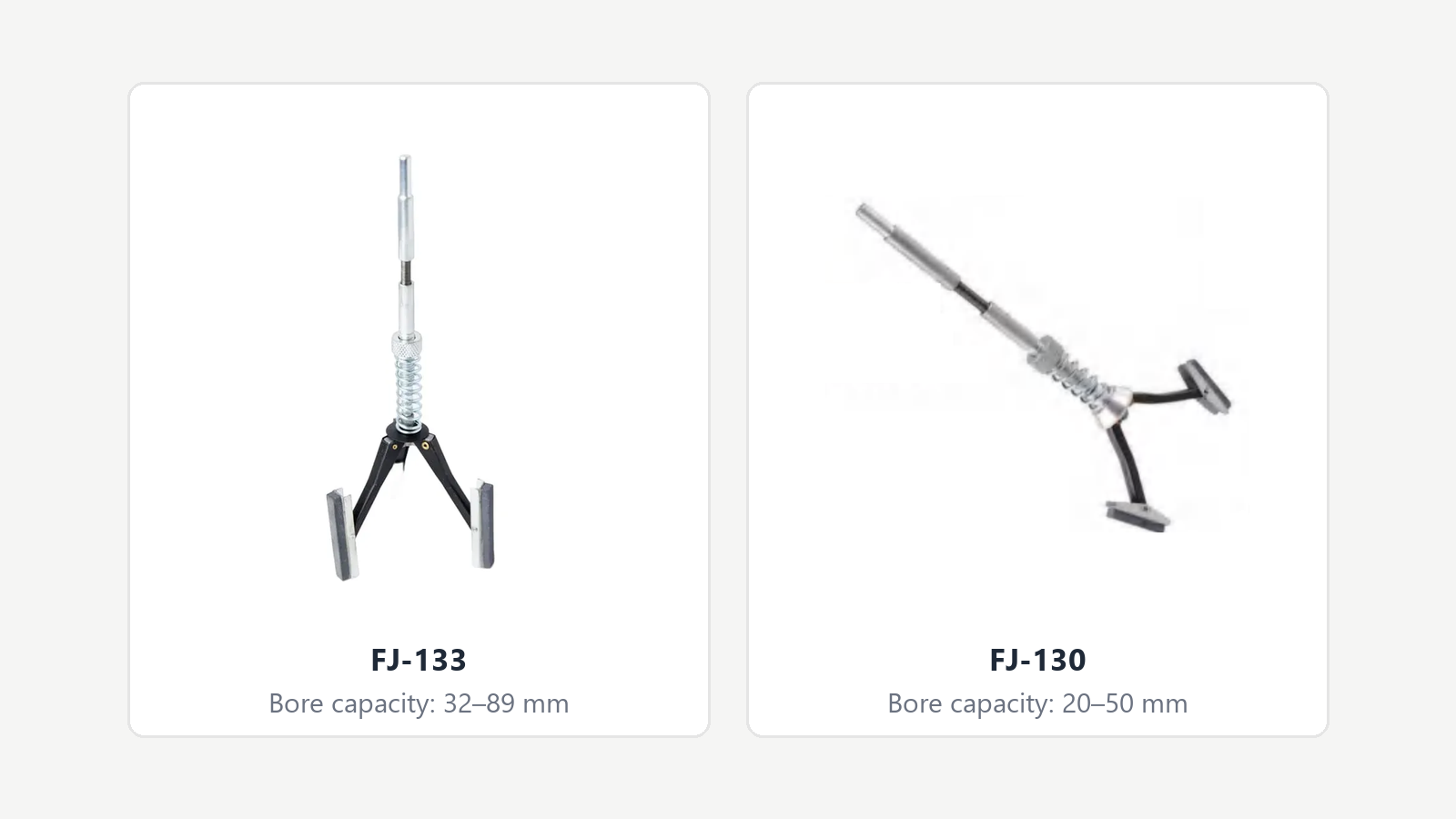
A cylinder hone should be selected from its published capacity range, not from the figure in its product name. The two TEKO models covered here publish two different ranges — 3/4" to 2" (20–50 mm) and 1-1/4" to 3-1/2" (32–89 mm) — and the ranges overlap between 32 and 50 mm. A nominal overlap does not confirm application interchange. Before ordering, confirm the bore diameter, the intended application, and the details the published data does not state.
2. Actual Bore Range Versus the Product Name
Both models carry a figure in the product name that is easy to mistake for the working range. The 1-1/8 in. Brake Cylinder Hone, 2-Claw is named with a 1-1/8 in. figure, and its published capacity is 3/4" to 2" (20–50 mm). The 2 in. Engine Cylinder Hone is named with a 2 in. figure, and its published capacity is 1-1/4" to 3-1/2" (32–89 mm). What the name figure refers to is not stated in the published data — so treat the name as an identifier, and order against the capacity line.
3. Adjustable Stone Hone versus Ball Hone
Two common cylinder hone designs used in engine and brake work are adjustable stone hones and flexible ball hones. An adjustable stone hone carries honing stones on arms that spread across a range of bore sizes, and the honing pressure is adjusted mechanically — the published description of the brake model states that a knurled nut controls adjustable honing tension for steady, smooth contact with the cylinder wall. A ball hone takes a different form: abrasive spheres on flexible bristles, made in fixed diameter sizes.
The sizing guidance published for ball hones is specific to that format. One flex-hone maker's selection guide distinguishes two cases: when the bore matches a standard nominal size, buyers select the corresponding tool; when the bore falls between two standard sizes, buyers select the next larger size. That rule is published for that maker's flexible honing products. It is not stated as a rule for every ball hone on the market, and it is not a rule for adjustable stone hones, which are selected by matching the bore to the tool's published capacity range.
The two designs are also built for different kinds of work. Industry sources commonly distinguish light deglazing from bore geometry correction, and a hone's correction behavior depends on the tool and the condition of the bore. The published data for these two models does not quantify that behavior, so it should not be assumed in either direction.
4. How to Read Capacity and Stone Size
Capacity is a range with edges
A published capacity is a range, and both edges mean something. A bore outside the published range is outside the tool's scope, and an application close to either edge is worth confirming with the supplier before ordering.
Stone size on the two TEKO models
The published stone sizes are 28×6 mm on the brake model and 51×7 mm on the engine model. These are physical dimensions of the stones supplied with the tool. The published data does not state a grit rating, a target surface finish, or application rules tied to the stone dimensions, and those attributes should not be inferred from size alone — buyers who need them specified should confirm them before ordering.
Worked examples: 25, 40 and 60 mm
Whether a bore diameter falls inside the published capacity range:
25 mm — inside the FJ-130 range (20–50 mm): yes. Inside the FJ-133 range (32–89 mm): no.
40 mm — inside the FJ-130 range: yes. Inside the FJ-133 range: yes, in the overlap band.
60 mm — inside the FJ-130 range: no. Inside the FJ-133 range: yes.
A yes means only that the diameter falls inside the published capacity range. It does not confirm application suitability — see the boundary discussion in the next section — and these examples are not a recommendation of one product over the other.
5. Engine Versus Brake Application Boundaries
What the two source levels say
The factory catalog describes FJ-130 as a tool for removing glaze and scratches from brake cylinders. TEKO's product page lists FJ-133 for engine-cylinder refinishing, although its factory catalog entry does not provide a separate application statement. Buyers who require factory-issued confirmation for a specific application should request it before ordering.
The overlapping range and what it does not prove
The two capacity ranges overlap between 32 and 50 mm, so a bore in that band falls inside both tools' published ranges. A nominal overlap is all it is. It does not prove that either hone is approved for the other's application. Application suitability is separate from capacity, and in the overlap band it should be confirmed independently before ordering.
6. TEKO FJ-133 and FJ-130 at a Glance
FJ-133 — 2 in. Engine Cylinder Hone. Capacity: 1-1/4" to 3-1/2" (32–89 mm). Stone size: 51×7 mm. Weight: 126.8 g. Packing: Slide Card, QTY 100, G.W./N.W. 14/13 kg, MEAS 48×33×27 cm. Range: Engine Service Tools.
FJ-130 — 1-1/8 in. Brake Cylinder Hone, 2-Claw. Capacity: 3/4" to 2" (20–50 mm). Stone size: 28×6 mm. Weight: 95 g. Packing: Slide Card, QTY 100, G.W./N.W. 12/11 kg, MEAS 48×33×27 cm. Range: Brake Service Tools.
7. Technical Details to Confirm Before Ordering
Several details a buyer may need are not part of the published data for either model, and each is a confirm-before-ordering item rather than an assumption:
The arm configuration of the engine model. The brake model's two-claw layout is part of its published name; the engine model's published record does not state its arm count.
The drive connection. Only the FJ-133 product page lists a Drill Diameter figure of 6 mm; shaft and chuck compatibility are not stated for either model.
The stone grit, and whether replacement stones are offered for either model.
The expected correction behavior on an out-of-round or tapered bore — not quantified for either tool.
The intended application inside the 32–50 mm overlap band.
Each can be confirmed with the supplier against the actual application.
8. B2B Sourcing Checklist
For importers and distributors building a cylinder hone program, the published records support a short, concrete sourcing checklist:
The bore sizes your customers need to cover, checked against the two published capacity ranges.
The actual applications — brake cylinder service, engine cylinder work, or both — confirmed for the overlap band.
Estimated annual quantities and target market.
Packaging requirements. The published packing specification for both products is a slide card at QTY 100 — packing data only; it is not a minimum order quantity and not a delivery commitment.
Private-label and branding requirements.
Packaging and private-label options are confirmed with the order discussion so the cartons and labels match the program.
9. Frequently Asked Questions
Is the figure in a cylinder hone's name its capacity?
No. The name figure and the capacity range are separate fields in the published data, and only the capacity field states which bores the tool spans.
Both ranges cover 32–50 mm. Does that mean either hone works for either job?
A nominal overlap does not confirm application suitability. Application fit in the overlap band should be confirmed separately before ordering.
What grit are the stones?
Not published. Buyers who need a specified grit should confirm it with the supplier before ordering.
What is not published for the engine model?
Its arm configuration, its drive connection details beyond the 6 mm Drill Diameter figure listed on its product page, the stone grit, and a factory application sentence.
Is QTY 100 the minimum order quantity?
No. QTY 100 is the published slide-card packing quantity — packaging data, not a purchase minimum or a delivery commitment.
10. Request a Configuration Check
Send us the cylinder bore sizes and applications you need to cover, together with your estimated quantities, target market and packaging or branding requirements. We will review the requirements against the published specifications and flag any details that need factory confirmation.
---