Oct 31, 2026Buyer Guides
How to Choose a Valve Spring Compressor: Type, Jaw Capacity & Engine Access
Compare valve spring compressors by type, jaw capacity, throat depth and engine access — why a universal label is not an application fit.
1. Quick Answer
A valve spring compressor should not be selected by "universal" labeling alone. Buyers should first identify the compressor type and service layout, then compare jaw capacity, throat depth and available access against the target cylinder head and valve spring position. A universal label describes an adjustment range — not which springs the jaws engage, how deep the tool reaches, or whether the style matches the service. Compare the published figures and the access requirement before ordering.
2. Why "Universal" Does Not Confirm Application Fit
Universal is a common word on valve spring compressor listings, and it is easy to read too much into it. In a specification, universal usually describes how far the jaws adjust — the range of spring and retainer sizes the tool can engage. It does not tell you where those springs sit in the head, how deep they are, or which service layout the tool was designed for.
Application fit is documented separately. A tool whose spec sheet reads universal jaw capacity still carries a separate application statement, and that statement — the engines, the valve arrangements and the access conditions it is meant for — is the part that has to match your job.
3. Start With the Valve Spring Compressor Type
Compressors for valve springs are built in several distinct formats. Some are bench-style frames for work on a removed cylinder head; some are lever formats operated by hand; professional ranges also include dedicated in-place designs that hold the valve through the spark-plug hole with compressed air, and versions that run on shop air.
The type decides how the tool mounts, what it needs to operate, and where it can physically work — before any figure on the spec sheet comes into play. Identify the compressor type and the service layout first, then use the figures in the following sections to compare tools of the same type.
4. Check Jaw Capacity Against the Required Opening
Jaw capacity is the range the jaws adjust across — the spring and retainer sizes they can engage. Professional makers publish it as an explicit figure, and it comes first in any comparison: a jaw that cannot open to the spring's size cannot do the job.
Read the capacity as a range and compare it against the springs on the target heads, size by size. A published range has edges: a retainer outside the range is outside the tool's scope, and an application close to either edge is worth confirming with the supplier.
5. Why Throat Depth Is a Separate Selection Factor
Throat depth is how far the jaws reach in from the edge of the tool toward the spring. Professional makers publish it as a separate figure — beside jaw capacity, not inside it — because the two measure different things.
That separation matters in practice. Two compressors can quote the same jaw capacity and still differ in throat depth, and a jaw that opens wide enough can still be too shallow for a spring seated well below the head surface. Read both figures together: the capacity says what the jaws can hold, the depth says where they can hold it.
6. How Deep-Seated Valves Change Access Requirements
Some engines place their valve springs close to the head surface; others seat them deeper, below surrounding castings and hardware. The deeper the spring sits, the further the tool has to reach past what surrounds it — until the space around the spring matters more than the spring itself.
A compressor's application statement is worth reading for exactly this reason. A tool documented for multi-valve petrol and diesel engines with deep-seated valves is saying something specific about access: its format and reach are intended for springs that are not easy to get at. Match that statement against the engines you service before comparing anything else.
7. Head-On vs Head-Off Service: Why the Difference Matters
Valve spring service happens in two settings. With the head removed, the work happens on a bench, and makers name compressors explicitly for that setting. With the head on the engine, the springs are inside the vehicle's cylinder head, surrounded by hardware, and professional makers build dedicated designs for it — including formats that hold the valve in place with compressed air while the spring is compressed.
An engine service procedure shows the same distinction: the service layout is established before the compressor tool is selected. Compressing a valve spring also stores mechanical energy in the spring and the tool, which is why professional ranges publish load ratings and safety instructions alongside the figures. Confirm how the job will be done — head on or head off — before selecting a compressor type.
8. How Cylinder-Head Layout Affects Tool Selection
Layout is what ties the other axes together. Overhead-cam and pushrod heads place the springs in different positions; multi-valve heads add more of them, closer together; deep-seated positions add reach. The same nominal spring size can present a very different working angle from one head to the next.
Professional makers write layout into their specifications: jaw and throat figures are published with notes on the head types a compressor fits. Read the layout first, then the figures — a compressor that suits one head design is not automatically suited to another.
9. What Buyers Should Compare Before Ordering
The compressor type and format, against the planned service setting — head on, or head off.
The jaw capacity, published as an explicit range.
The throat depth, published separately, against how deep the springs sit.
The documented application scope — engines, valve arrangements and access conditions.
The operating requirement, where the format needs more than hand force.
Documented this way, two compressors can be compared line by line against the same target application — and the configuration that was quoted is the configuration that arrives.
10. TEKO Confirmed Configuration — FJ02-015
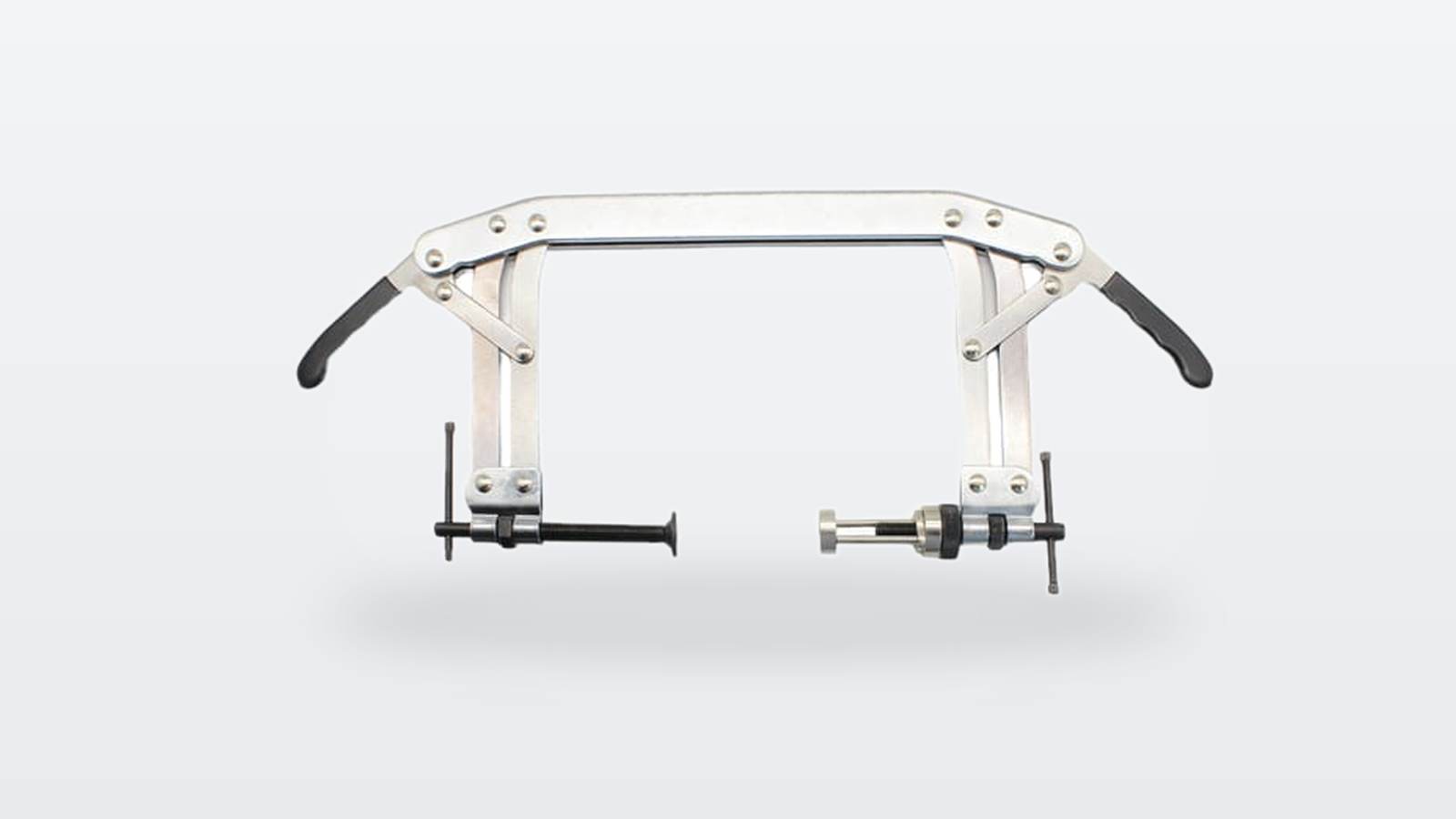
FJ02-015, the Multi Valve Spring Compressor, is a carbon steel valve spring compressor documented for use on multi-valve petrol and diesel engines with deep-seated valves. The published universal jaw capacity is 55–175 mm and the throat depth is 165 mm. It is packed as a paper tag, QTY 5, G.W./N.W. 12.5/12 kg, MEAS 46×22×27 cm, in the Engine Service Tools range.
Use the published jaw capacity, throat depth and application scope as the product reference. Application fit should still be checked against the target cylinder head, the valve spring position and the planned service layout. Send the engine layouts, the spring positions and the access conditions so the configuration can be checked against them. For different packaging, labeling or branding, send the requirement with your inquiry.
11. Frequently Asked Questions
Does a universal label mean the compressor fits any engine?
No. Universal describes how far the jaws adjust. The application — the engines, valve arrangements and access conditions the tool is documented for — is stated separately and is what has to match the job.
Why are jaw capacity and throat depth listed as two separate figures?
They measure different things. Jaw capacity is the range of springs the jaws can engage; throat depth is how far the jaws reach toward the spring seat. A tool can have enough of one and not the other.
Can the same compressor be used with the head on and with the head off?
Not necessarily. Makers name and build compressors for each setting — bench frames for a removed head, dedicated designs for working in place. Confirm the service layout before choosing a type.
What should buyers confirm about the target engine?
The valve spring positions, how deep they sit, the head layout and the access around the springs. An engine name alone does not confirm any of these.
What should distributors confirm before ordering a valve spring compressor?
The compressor type, the published jaw capacity and throat depth, the documented application scope, the storage or packaging format, and private-label options.
12. Request a Configuration Check
Send us the valve spring applications and engine layouts you need to cover, and we will confirm which available configuration fits your program.
---