Oct 28, 2026Buyer Guides
How to Choose a Valve Stem Seal Tool Set: Seal Sizes, Reach & Removal/Installation Coverage
Compare valve stem seal tool sets by seal size coverage, removal and installation functions, and reach — why a size match alone is not an application fit.
1. Quick Answer
A valve stem seal tool set should not be selected by piece count alone. Buyers should confirm the seal sizes to be covered, whether the set supports removal, installation or both, and whether the tool can reach the seal in the intended engine layout. A piece count does not show which sizes are included, which functions the kit performs, or whether the geometry reaches the seal. Confirm the size list, the function list and the access conditions before comparing kits.
2. Why Piece Count Alone Does Not Define Coverage
A piece count tells you how many pieces a kit contains. It does not tell you which seal sizes the pieces engage, whether the kit removes seals, installs them, or does both, or whether the tool geometry reaches a seal set deep in the cylinder head. Two kits with the same count can cover different size ranges or different functions.
Read the kit as a list of capabilities rather than as a number: the size list first, the function list second, and the reach question third. Those are the fields a supplier can confirm in writing.
3. Start With the Seal Sizes You Need to Cover
Seal size coverage is published as an explicit list: in this tool family, the sizes refer to the seals the pieces are made to engage. Installation adapters, for example, are documented as fitting seals of 5, 5.5, 6, 6.6, 7, 8 mm and 3/8″ — a size list, not a range.
Compare the published size list against the seals fitted to the engines you service, size by size rather than as a range. A size missing from the kit is a question to resolve with the supplier before ordering, not an assumption to make.
4. Removal Tools and Installation Tools Serve Different Functions
Removing a valve stem seal means gripping the old seal around the valve stem and drawing it off. Installing one means driving a new seal squarely onto the valve guide. Service manuals treat the two as separate steps with separate tools, designating a dedicated installation tool for the job and cautioning that improper installation can let oil leak past the valve guide.
Some kits are single-function; others combine a removal plier with driving components for installation. Confirm which functions a set performs before comparing piece counts: a removal-only kit does not install new seals, and an installation kit does not pull the old ones off.
5. Why Reach and Access Matter
A valve stem seal sits in a recessed position around the valve stem, usually below the camshaft hardware. The plier has to reach down around the stem into that confined area to grip the seal, so the space around the seal — not just its size — decides whether the tool can be positioned and operated.
Tool makers answer this with access-oriented designs: long-reach jaws for recessed valves on multi-valve heads, long necks that extend into narrow areas. If the tool cannot reach, grip and work the seal at its working angle, a matching size list does not help. Confirm the access conditions on your applications before settling on a format.
6. How Engine Layout Changes Tool Selection
The same nominal seal size can sit in very different places. Deep or recessed positions, multi-valve heads and the arrangement of camshaft hardware all change the working angle and the clearance around the seal.
Service procedures for some engines list straight and angled seal pliers as two separate tools, because the positions they serve do not present the same access. Where the seal sits and what surrounds it can matter as much as the size it carries, so expect geometry, not just size, to decide usability.
7. Why Size Match Alone Does Not Confirm Application Fit
A size match is not an application match. The published size list shows which seals the set can engage; it does not show whether the tool can be positioned in the engine in front of you, or whether the kit's functions match the job.
An engine or vehicle reference is a starting point for confirmation, not proof of fit: valve sizes and hardware layouts vary within engine families, and the access around a seal can differ between positions in the same head. Confirm the size list, the function list and the access conditions on the specific application before ordering, and put any gap to the supplier in writing.
8. What Buyers Should Check in the Kit Configuration
When a set is quoted, check the configuration by capability rather than by headline count:
The functions covered — removal, installation, or both.
The seal sizes covered, listed individually.
Whether installation is supported by dedicated driving components, and for which seal sizes.
The plier format and working length, against the access space around the seal.
The case or storage format the set is supplied in.
A configuration documented this way can be compared line by line between kits and held to at delivery. A quotation that only states a piece count has not yet been specified.
9. What Distributors Should Ask a Supplier to Document
The size list, by individual seal size, not only the piece count.
The functions the kit supports — removal, installation, or both.
The plier format and its working reach, against the intended engine layouts.
The application scope the set is documented for.
The storage or case format.
These fields let a distributor compare sets on the same basis and hold the supplier to the configuration that was agreed.
10. TEKO Confirmed Configuration — FJ02-S02
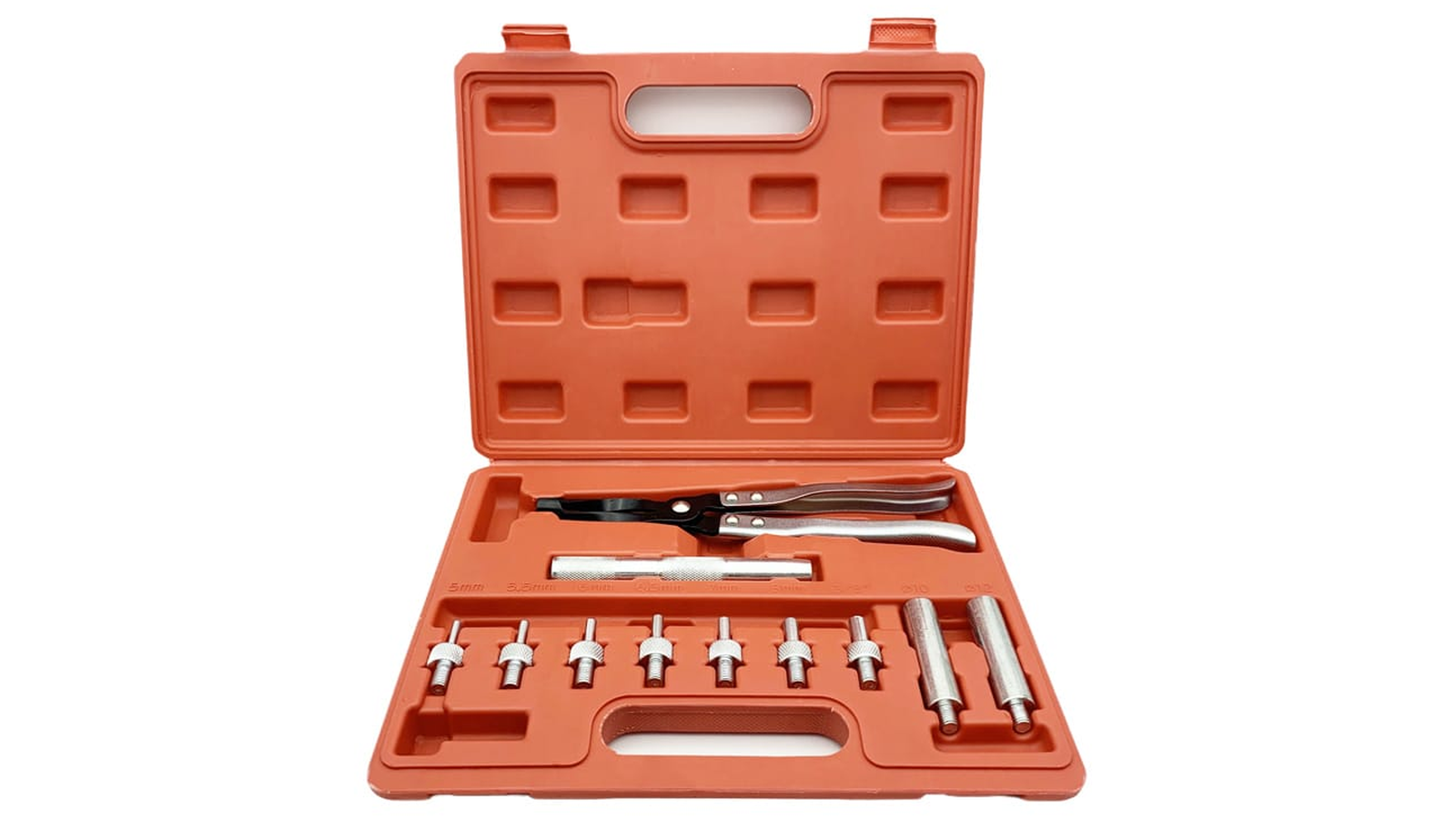
FJ02-S02, the Valve Stem Seal Tool Set, is documented for the removal and installation of valve stem seals on overhead camshaft engines. The published size list is 5, 5.5, 6, 6.5, 7, 8 mm and 3/8″. The listed material is 45# carbon steel and the weight is 1.56 kg. It is packed as a box, QTY 10, G.W./N.W. 16.5/16 kg, MEAS 53×34×27 cm, in the Engine Service Tools range.
The published documentation states that the valve pliers reach down around the valve stem into the confined areas of the seal, to grip it for removal / installation. Use the published size list, the documented removal / installation scope and the packing data as the product reference. Application fit should still be checked against the target engine layout and the access conditions on your applications. Send the seal sizes, the functions you need and the access conditions so the configuration can be checked against them. For different packaging, labeling or branding, send the requirement with your inquiry.
11. Frequently Asked Questions
Does the piece count tell me what a valve stem seal tool set covers?
No. A piece count does not show which seal sizes are included or whether the kit removes seals, installs them, or both. Read the size list and the function list instead.
Why do removal and installation need different tools?
Removal grips and draws off the old seal; installation drives a new seal squarely onto the valve guide. Service manuals treat them as separate steps with dedicated tools, and improper installation can let oil leak past the valve guide.
Why can a tool with the right size still fail to reach the seal?
Because a size fit is not a reach fit. Recessed positions and the hardware around the seal change the working angle, and the tool has to reach around the valve stem into the confined area to grip it.
Is the engine name enough to choose the set?
Not by itself. Valve sizes and hardware layouts vary within engine families, so confirm the size list, the functions and the access conditions on the specific application.
What should distributors confirm before ordering a valve stem seal tool set?
The itemised seal sizes, the functions the kit supports — removal, installation, or both — the plier reach against the intended engine layouts, the storage format, and packaging or private-label options.
12. Request a Configuration Check
Send us the valve stem seal applications and kit configuration you need to cover, and we will confirm which available configuration fits your program.
---